
By Brigadier General Sani Kukasheka Usman (Rtd), mni, PhD, fnipr
A Nation Honours Its Army
Every nation reserves a special moment to honour the men and women who dedicate their lives to defending its sovereignty, preserving its unity and safeguarding its people. Such occasions are more than ceremonial observances; they are opportunities for reflection, gratitude and renewed appreciation of the sacrifices made daily by members of the armed forces in the service of their country.
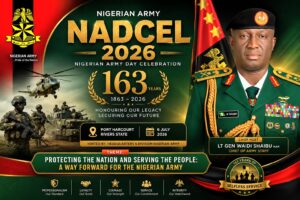
For Nigeria, that moment comes every 6 July with the Nigerian Army Day Celebration (NADCEL), the annual commemoration of the Nigerian Army’s enduring commitment to national service. This year’s celebration, being hosted in Port Harcourt, Rivers State, by the Headquarters, 6 Division Nigerian Army, marks the Army’s 163rd anniversary and provides another opportunity to honour generations of officers, soldiers, civilian personnel, veterans and their families whose dedication has helped shape Nigeria’s history and safeguard its future.
The choice of Port Harcourt adds special significance to this year’s celebration. Beyond being one of Nigeria’s foremost economic centres, the city serves as the headquarters of 6 Division Nigerian Army, a young formation that occupies a strategic position in protecting the nation’s critical oil and gas infrastructure and maintaining security across the Niger Delta and the South-South geopolitical region. Against this backdrop, NADCEL 2026 is not only a celebration of history but also a recognition of the Army’s continuing relevance in addressing contemporary security challenges and enhancing the nation’s economy.
Military commemorations are a longstanding tradition across the world. From France’s Bastille Day parade on the Champs-Élysées to the United States Armed Forces Day, India’s Army Day and similar observances in many other countries, nations continue to acknowledge the indispensable role of their armed forces in preserving peace, defending sovereignty and promoting national stability. Nigeria’s annual celebration of NADCEL proudly reflects this enduring global tradition while providing a uniquely Nigerian occasion to recognise the courage, professionalism and selfless service of its Army.
163 Years of Service
The Nigerian Army traces its origins to 1863 with the formation of the Glover Hausas, the modest military force that eventually evolved into today’s modern Army. From those humble beginnings, it has grown into one of Nigeria’s foremost national institutions, deeply woven into the country’s political evolution, national unity and socio-economic development.
Over the past 163 years, the Nigerian Army has continually adapted to changing national and international realities. From colonial campaigns through independence and post-independence nation-building, the institution has evolved into a highly professional force capable of responding to both conventional and asymmetric security threats. Its development reflects not only organisational growth but also the resilience and adaptability that have characterised its long and distinguished history.
Throughout its evolution, the Army has remained steadfast in its constitutional responsibility of defending Nigeria’s sovereignty and protecting its territorial integrity. Equally important, it has continued to strengthen its institutional capacity through improved doctrine, professional training, operational experience and strategic partnerships, ensuring that it remains prepared to confront emerging security challenges.
Defending Nigeria Through the Decades
The history of modern Nigeria cannot be fully told without acknowledging the central role played by the Nigerian Army in some of the nation’s defining moments. During the Second World War, Nigerian troops served with distinction in campaigns across Africa and Asia, earning international recognition for their courage, discipline and professionalism. Their contributions formed an important chapter in Nigeria’s military heritage and laid the foundation for the Army’s future development.
Following independence, the Army assumed even greater national responsibilities. During the Nigerian Civil War, it played a decisive role in preserving the country’s unity and territorial integrity at one of the most difficult periods in Nigeria’s history. In the decades that followed, the Nigerian Army became a leading contributor to peace support operations across Africa and beyond, particularly under the auspices of the United Nations, the African Union and the Economic Community of West African States (ECOWAS). Its personnel distinguished themselves in numerous peacekeeping and peace enforcement missions, helping to restore stability in conflict-affected countries while enhancing Nigeria’s international standing as a responsible regional and continental leader.
Today, the Nigerian Army remains one of the principal pillars of Nigeria’s national security architecture. It continues to fulfil its constitutional mandate through counterinsurgency, counterterrorism and internal security operations across various theatres, working alongside sister services and other security agencies to combat insurgency, terrorism, banditry, kidnapping, crude oil theft, separatist violence and other threats to national peace and stability. In doing so, the Army continues to demonstrate the resilience, professionalism and commitment that have defined its service to the nation for more than a century and a half.
Meeting Today’s Security Challenges
The security landscape confronting Nigeria today is markedly different from that of previous decades. The nature of conflict has evolved from conventional warfare to a complex mix of insurgency, terrorism, banditry, kidnapping, separatist violence, transnational organised crime and attacks on critical national infrastructure. These multidimensional threats demand not only military strength but also strategic adaptability, technological innovation and close collaboration among security agencies and the civilian population.
Against this backdrop, the Nigerian Army has remained at the forefront of national efforts to safeguard the country’s sovereignty and preserve internal stability. Across the North-East, North-West, North-Central, South-East, South-South and other operational theatres, officers and soldiers continue to undertake demanding missions under arduous conditions in pursuit of lasting peace and security. Their operational resilience, discipline and professionalism have contributed significantly to disrupting criminal networks, reclaiming territories previously threatened by violent extremists, protecting vulnerable communities and restoring public confidence in many affected areas.
These achievements have often come at considerable cost. Many gallant officers and soldiers have paid the supreme price in the line of duty, while others have sustained injuries or continue to serve under difficult and hazardous conditions far from their families. Their sacrifices serve as a poignant reminder that the security enjoyed by the nation is underpinned by the courage, commitment and selflessness of men and women who place national interest above personal comfort and safety.
For this reason, NADCEL is more than an anniversary celebration. It is also a solemn occasion to honour those who made the ultimate sacrifice in defence of the nation, recognise those who continue to serve with distinction and reaffirm the country’s collective appreciation for their dedication.
Building a Modern Fighting Force
Modern security challenges require a military institution that is agile, innovative and forward-looking. Recognising this reality, the Nigerian Army has continued to pursue an ambitious transformation agenda aimed at strengthening its operational effectiveness while adapting to an increasingly dynamic security environment.
This transformation is evident in sustained investments in professional military training, doctrinal development, specialised training, indigenous research and development, technological innovation and enhanced operational capabilities. The Army has also continued to improve joint operations with sister services and deepen collaboration with other security agencies in addressing increasingly complex security threats.
Equally significant is the growing emphasis on self-reliance through indigenous solutions to operational challenges. From locally developed military equipment and engineering innovations to expanded research initiatives and enhanced logistics support, the Nigerian Army continues to demonstrate an encouraging commitment to building institutional resilience while reducing dependence on external sources for critical operational requirements.
Beyond technology and equipment, however, the Army’s greatest strength remains its people. Continuous investment in leadership development, personnel welfare and professional ethics, has further reinforced its reputation as a disciplined institution committed to excellence, accountability and service to the nation.
Building on a Legacy of Leadership
One of the greatest strengths of the Nigerian Army lies in the continuity of its leadership and the enduring institutional legacy built by successive Chiefs of Army Staff. Across generations, each has contributed in different ways to strengthening the institution’s operational capability, professionalism and responsiveness to the nation’s security needs. Their enduring legacies are reflected in sustained investments in personnel development, doctrinal reforms, force modernisation, operational effectiveness, personnel welfare and civil-military relations. Their collective vision and stewardship have transformed the Nigerian Army into one of Africa’s foremost military institutions, capable of responding to an increasingly complex and dynamic security environment.
Building upon these enduring foundations, the present Chief of Army Staff, Lieutenant General Waidi Shaibu, has continued to advance the Army’s transformation through a leadership philosophy anchored on professionalism, combat readiness, troop welfare, innovation and operational excellence. Central to his command philosophy is the “Soldier-First” mantra, institutionalised through the PROSE Command Philosophy, which recognises that a well-trained, well-motivated and well-supported soldier is the foundation of operational effectiveness, mission success and institutional excellence. By placing personnel welfare, professional development, ethical leadership and operational preparedness at the heart of the Army’s transformation agenda, the philosophy reinforces the enduring principle that the Nigerian Army’s greatest strategic asset is its people.
This deliberate focus on the soldier has strengthened morale, enhanced operational readiness and reinforced the Army’s capacity to confront evolving security challenges while remaining faithful to its constitutional responsibility of protecting the nation and serving its people. In many respects, Lieutenant General Shaibu’s leadership reflects both continuity and renewal, demonstrating that enduring institutions are strengthened not merely by change but by building progressively upon the achievements and legacies of those who came before.
Protecting the Nation and Serving the People
The theme of NADCEL 2026, “Protecting the Nation and Serving the People: A Way Forward for the Nigerian Army,” captures the essence of the Army’s constitutional mandate and its evolving relationship with the society it serves.
Beyond emphasising the defence of Nigeria’s sovereignty and territorial integrity, the theme clearly stresses the importance of professionalism, accountability, innovation and service. It recognises that effective national security extends beyond military capability alone and requires the confidence, trust and cooperation of the people.
Perhaps more importantly, the theme reflects an enduring truth about democratic societies: the military exists not apart from the people but in service to them. The Nigerian Army derives its strength from the nation it protects, while the nation’s peace and stability depend significantly on the dedication and professionalism of its armed forces. Sustaining this mutually reinforcing relationship remains essential to addressing both present and future security challenges.
Why Port Harcourt Matters
The selection of Port Harcourt, Rivers State, as the host city for NADCEL 2026 is both symbolic and strategically significant. As the capital of Rivers State and one of Nigeria’s foremost commercial and energy centres, Port Harcourt occupies a central place in the nation’s economic architecture. The city serves as a major hub for Nigeria’s oil and gas industry, making the security of the wider Niger Delta region a matter of critical national importance.
Hosting the Army’s 163rd anniversary in this strategic environment appropriately highlights the indispensable role of military formations deployed to protect the nation’s economic lifelines. It also draws national attention to the remarkable efforts of officers and soldiers who operate in one of the country’s most challenging security environments.
An interesting coincidence further enriches this year’s celebration. The commemoration of the Nigerian Army’s 163rd anniversary on 6 July at the Headquarters of 6 Division, Nigerian Army, creates a memorable symbolic alignment that adds a unique character to NADCEL 2026. Whether coincidental or carefully conceived, the convergence of the date and the host formation contributes an additional layer of significance to this historic occasion.
The Strategic Importance of 6 Division of the Nigerian Army
Beyond its symbolic value, the Headquarters, 6 Division Nigerian Army occupies a position of immense operational importance within Nigeria’s contemporary security architecture.
Responsible for military operations across much of the Niger Delta, the Division plays an important role in protecting critical national infrastructure, combating crude oil theft, curbing pipeline vandalism, countering sea piracy and addressing other forms of economic sabotage that threaten Nigeria’s economic stability.
Working closely with Operation DELTA SAFE, sister services and other security agencies, the Division has recorded notable operational successes that have strengthened security across the region, improved the protection of vital national assets and contributed to increased crude oil production and government revenue. These achievements demonstrate that safeguarding national security extends beyond defending territorial boundaries; it also involves protecting the economic resources upon which national development depends.
The choice of 6 Division as host of NADCEL 2026 therefore appropriately recognises both its operational accomplishments and the strategic importance of the Niger Delta to Nigeria’s overall peace, stability and economic prosperity.
Beyond the Battlefield
The Nigerian Army’s contribution to national development extends well beyond its traditional role as the country’s principal land fighting force. While its primary constitutional responsibility remains the defence of Nigeria’s sovereignty and territorial integrity, the Army has consistently demonstrated that military service also encompasses humanitarian assistance, disaster response and community development.
Across the country, the Nigerian Army has undertaken numerous initiatives aimed at improving the lives of ordinary Nigerians. Through medical outreaches, educational support programmes, skills acquisition initiatives, infrastructure development projects and other community-based interventions, formations and units have continued to complement government efforts in promoting the welfare of host communities. During emergencies and natural disasters, troops have also provided timely support to civil authorities through search and rescue operations, relief distribution and the restoration of essential services, including humanitarian interventions in states such as Borno, Kogi and Niger. These initiatives reflect the Army’s enduring commitment not only to defending the nation but also to supporting national development and enhancing the well-being of the people it serves.
These interventions reflect an institution that recognises the inseparable relationship between national security and human security. By responding not only to armed threats but also to humanitarian needs, the Nigerian Army continues to strengthen public confidence and reaffirm its commitment to serving the nation in its broadest sense.
This year’s NADCEL theme, “Protecting the Nation and Serving the People: A Way Forward for the Nigerian Army,” aptly captures this dual responsibility. It further shows the reality that protecting lives and supporting communities are complementary responsibilities that reinforce the Army’s constitutional mandate and deepen its bond with the people.
The Human Face of Service
Behind every successful military operation lies the dedication and sacrifice of thousands of individuals whose contributions often receive little public recognition. Among them are the Nigerian Army’s civilian staff, whose expertise and professionalism provide indispensable administrative, technical and logistical support for military operations. Though their work is largely carried out behind the scenes, it remains essential to the efficient functioning and operational effectiveness of the Service.
Equally deserving of recognition are the families of serving personnel. Military service inevitably places enormous demands not only on the officers and soldiers of the Nigerian Army but also on their spouses, children and loved ones. Long deployments, prolonged separations and the uncertainty associated with operations in volatile theatres impose emotional and psychological burdens on their families that are rarely visible to the wider public.
The quiet resilience of these families constitutes an often-overlooked pillar of military effectiveness. Their patience, understanding, encouragement and prayers sustain morale and enable officers and soldiers to discharge their responsibilities with confidence and determination. Their sacrifices, though seldom acknowledged publicly, are woven into every operational success achieved by the Nigerian Army.
The invaluable contributions of the Nigerian Army Officers’ Wives Association (NAOWA) and the Nigerian Army Soldiers’ Wives Association (NASWA) also deserve special recognition. Across formations and units of the Nigerian Army nationwide, these associations have continued to complement the Army’s welfare initiatives through programmes that promote education, healthcare, skills acquisition, economic empowerment and social support for the families of serving personnel, veterans and widows. Their humanitarian interventions and community development activities have not only improved the well-being of military families but have also strengthened civil-military relations by extending assistance to neighbouring civilian communities. Through their compassion, resilience and unwavering commitment to service, NAOWA and NASWA have become indispensable partners in advancing the welfare of the Nigerian Army family and reinforcing the human dimension of military service.
The nation must also remember those who have borne the heaviest burden of service. In recent years, the Nigerian Army has lost courageous officers and soldiers in the line of duty, while many others have been wounded or continue to recover from injuries sustained during operations. These sacrifices serve as enduring reminders of the high price paid daily by members of the Armed Forces in defence of Nigeria’s peace, unity and security.
Their courage deserves not only remembrance but also enduring national gratitude. By honouring the fallen heroes and supporting those who continue to serve, Nigerians reaffirm the values of patriotism, duty and selfless service that have long defined the military profession.
AFRILAFF and International Participation
NADCEL 2026 is particularly significant because it is being held alongside the Third African Land Forces Forum (AFRILAFF), an event that further reinforces Nigeria’s leadership in regional security cooperation and defence diplomacy.
The forum brings together Army Chiefs, senior military officers, defence experts and strategic thinkers from across the African continent to exchange ideas on emerging security challenges, strengthen military cooperation and explore innovative approaches to enhancing peace and stability. At a time when many security threats transcend national borders, such collaboration has become increasingly important in developing coordinated responses to terrorism, violent extremism, transnational organised crime and other shared challenges confronting African nations.
The inclusion of defence exhibitions showcasing modern military equipment, emerging technologies and indigenous innovations further enriches the forum by highlighting advances in defence capability while encouraging greater collaboration among participating countries.
The impressive level of international participation points to the growing importance of AFRILAFF as a continental platform for professional military engagement. Reliably, Army Chiefs from Mauritania, Ghana, Guinea-Bissau, Sierra Leone, Cameroon, the Central African Republic, Tanzania, Rwanda, South Africa and Namibia have confirmed their participation, reflecting the confidence reposed in Nigeria’s leadership and its continuing commitment to advancing collective security across Africa.
Beyond strengthening professional relationships among African militaries, the forum also reinforces Nigeria’s longstanding contribution to regional peacekeeping, conflict resolution and defence cooperation. It provides another opportunity for the Nigerian Army to share operational experiences, deepen strategic partnerships and contribute meaningfully to discussions on the future of land warfare and regional security.
Honouring the Legacy of Courage
One of the defining highlights of this year’s celebration will be the presentation of the Chief of Army Staff Combat Veterans Award to seven distinguished veterans of the Economic Community of West African States Monitoring Group (ECOMOG).
The award recognises their exceptional courage, selfless service and invaluable contributions to restoring peace and stability in West Africa during some of the sub-region’s most turbulent periods. It is also a tribute to the generations of Nigerian soldiers whose professionalism and sacrifice earned widespread respect for Nigeria’s military both at home and abroad.
Among this year’s recipients is His Royal Majesty, Major General Felix Agho Mujakperuo (Rtd), Orhue I, Orodje of Okpe, CFR mni, the only surviving ECOMOG Force Commander. His recognition symbolises the enduring legacy of those who led multinational peace operations with distinction and whose leadership helped shape the history of peacekeeping in West Africa.
By honouring these veterans, the Nigerian Army pays tribute not only to individual acts of gallantry but also to an enduring tradition of courage, professionalism and regional service. Their achievements continue to inspire younger generations of officers and soldiers while reminding Nigerians that the Army’s history has been defined not only by defending the homeland but also by promoting peace, stability and security across the African continent.
Strengthening Civil-Military Relations
One of the enduring messages of NADCEL 2026 is that national security is a shared responsibility. While the Nigerian Army bears the constitutional mandate of defending the nation’s sovereignty and protecting its territorial integrity, lasting peace and security can only be achieved through a strong and enduring partnership between the military and the people.
The Nigerian Army is not an institution apart from society. It is composed of Nigerians drawn from every community across the country: our sons and daughters, brothers and sisters, neighbours and friends, who have voluntarily chosen the demanding profession of arms in service to the nation. Their successes on the battlefield are strengthened by the confidence, cooperation and goodwill of the citizens they are sworn to protect.
Building and sustaining this relationship requires mutual trust, understanding and respect. Public confidence enhances operational effectiveness, just as military professionalism reinforces public trust. As contemporary security threats become increasingly complex and often transcend conventional military responses, collaboration between the Armed Forces, other security agencies and the citizenry becomes ever more indispensable. Intelligence sharing, community support and constructive civic engagement remain vital components of an effective national security architecture.
Accordingly, sustained public support for the Nigerian Army and the Armed Forces of Nigeria through understanding, cooperation, constructive engagement and prayers remains essential to the successful discharge of their constitutional responsibilities. Such support not only strengthens troop morale but also reinforces national resilience and contributes to a safer, more secure and more united Nigeria.
Looking Ahead
As the Nigerian Army commemorates 163 years of dedicated service to the nation, NADCEL 2026 provides an opportunity not only to celebrate past accomplishments but also to reflect on the responsibilities that lie ahead. The security environment will undoubtedly continue to evolve, presenting new and increasingly sophisticated challenges that will require innovation, adaptability and professionalism.
The Nigerian Army has repeatedly demonstrated its capacity to evolve with changing realities. From its humble origins in 1863 to its present role as one of Nigeria’s foremost national institutions, it has consistently adapted its doctrine, capabilities and operations to meet the demands of each era. Today, its continued commitment to counterinsurgency, counterterrorism and other internal security operations underscores its determination to confront emerging threats while remaining steadfast in the defence of Nigeria’s sovereignty, constitutional order and national unity. As the Army looks to the future, its continued emphasis on a Soldier-First culture, one that prioritises the welfare, professionalism and preparedness of its personnel, will remain fundamental to sustaining operational effectiveness, strengthening public confidence and fulfilling its constitutional mandate of protecting the nation and serving the people.
This year’s celebration also carries a broader message. While the official NADCEL 2026 theme, “Protecting the Nation and Serving the People: A Way Forward for the Nigerian Army”, affirms the army’s enduring commitment to national service, the complementary message, “Our People, Our Army,” adopted for the Chief of Army Staff Literary Competition, beautifully reinforces the inseparable bond between the Nigerian Army and the citizens it proudly serves. The competition attracted an impressive 1,247 entries from pupils and students across Nigeria in the essay, poetry and arts categories, reflecting the remarkable level of public interest and youthful engagement with the ideals of patriotism, national service and civil-military relations. I am particularly honoured to serve as a member of the assessment team for the Chief of Army Staff Literary Competition 2026, an experience that has afforded me the privilege of witnessing firsthand the creativity, patriotism and intellectual depth demonstrated by young Nigerians from across the country. Together, the NADCEL theme and the competition’s complementary message affirm a simple but profound truth: national security is strongest when the military and the people work together in mutual trust, shared responsibility and common purpose.
Over the decades, the Nigerian Army has distinguished itself as a bastion of courage, resilience, patriotism and selfless service, standing as a formidable shield against forces that seek to undermine Nigeria’s peace, unity and sovereignty. Through immense sacrifices, often made under the most challenging and perilous conditions, its gallant officers and soldiers have remained steadfast in defending the nation’s territorial integrity and constitutional order while confronting insurgency, terrorism, banditry, kidnapping, separatist violence, crude oil theft and other threats to national security with remarkable professionalism, determination and resolve.
As Nigerians celebrate NADCEL 2026, it is fitting to honour not only those who currently wear the uniform but also the veterans who served with distinction, the civilian staff whose quiet dedication sustains the institution, and the families whose sacrifices make military service possible. Their collective contributions have helped preserve the nation’s unity, strengthen its democratic institutions and create a more secure environment for national development.
May this year’s celebration renew our appreciation of the Nigerian Army’s distinguished legacy, inspire greater patriotism and strengthen the enduring partnership between the military and the people. Above all, may it reaffirm our collective resolve to build a peaceful, secure and prosperous Nigeria, where the ideals of service, sacrifice and national unity continue to guide future generations.
Happy Nigerian Army Day Celebration (NADCEL) 2026 to the gallant officers, soldiers, civilian staff, veterans and families of the Nigerian Army!!
Brigadier General Sani Kukasheka Usman (Rtd), mni PhD fnipr, is a former Director of Army Public Relations and spokesperson for the Nigerian Army. He is a security and strategic communications expert, a seasoned public relations consultant, and a public affairs commentator.