From Edirin Robinson, in Kaduna
When Justina Dio last spoke with her husband, she was preparing to join him for his younger brother’s burial.
Hours later, she was searching for answers.
Her husband, Dio Idon, had travelled to Angwan Turunku following news of his brother’s death. Before leaving, he told her to get ready for the funeral. But when she tried calling him again, his phone was switched off.
By the time she arrived in the community, there was no husband to bury. All that remained were ashes.
“What they did is bad because they knew my husband did not kill his brother,” she said. “Now he is dead and we have no support except what the church is giving us.”
Left alone to raise four children, Justina is one of many Nigerians whose lives have been shattered by jungle justice, a form of mob action that continues to claim lives across the country despite constitutional protections and criminal justice institutions.
The tragedy began on January 3, 2026, when Dio received a call informing him that his younger brother, who had been ill for some time, had died.
As he prepared to return home and comfort his grieving family, another call came in. This time, it was a warning.
A resident of Angwan Turunku informed him that some community members were planning to attack him.
According to his superior in the Evangelical Church Winning All (ECWA), Rev. Alari, rumours had spread that Idio was responsible for his brother’s death.
“His colleague, who is a resident pastor in the community, called and warned him not to return because rumours had circulated that he was a wizard who caused his brother’s death,” Rev. Alari said.
“The majority of the villagers, especially the youths, were already convinced that he should be held responsible.”
Despite the warning, Idio chose to return home.
Those who knew him said he believed the truth would protect him. He wanted to pay his last respects to his brother and support his family during their time of grief.
Instead, he walked into a mob.
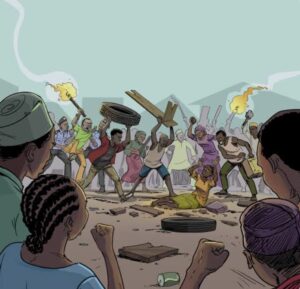
Upon arriving in Turunku, he was seized by residents who demanded that he either resurrect his dead brother or pay with his own life.
He was beaten mercilessly.
“When the resident pastor called us, we were shocked because we had not been informed about the situation,” Rev. Alari recalled.
“Had we known, we would have prevented him from travelling.”
Attempts to save him failed.
According to Rev. Alari, even the village head could not control the crowd.
“The attackers were too many and they all wanted him dead,” he said.
“The resident pastor tried to hide him, but the mob threatened him and his family. Even the police could do nothing because they feared for their own lives.”
On January 4, barely 24 hours after his brother’s death, Dio was burned alive.

By the time church officials and family members arrived, there was nothing left to bury except his ashes.
According to Rev. Alari, the allegations against Dio were fueled by family disputes and rumours.
“The whole thing started with children saying that if Dio was captured, he could bring his brother back to life,” he said.
“From there, the rumour spread and escalated into jungle justice.”
The consequences were devastating.
A ministry lost one of its staff members.
A mother lost a son.
A wife lost her husband.
Four children lost their father.
For Dr. Terngu Gwar, Kaduna State Coordinator of the National Human Rights Commission (NHRC), incidents like this reflect a growing breakdown of trust in formal justice institutions.
“Jungle justice occurs when non state actors take the law into their own hands and decide how justice should be served,” he said.
“Over the years, this has resulted in extrajudicial killings, mob violence and attacks on people merely perceived to have committed an offence.”
According to him, the practice directly violates the rule of law because it denies suspects the opportunity to defend themselves.
“There is no fair hearing, no legal representation and, most importantly, no respect for the right to life,” he said.
“A person’s life can be taken depending on the mood of a crowd. No matter the allegation, no group of citizens has the right to take another person’s life.”
He stressed that institutions already exist to investigate crimes and administer justice.
“When people are prevented from defending themselves before legally recognised institutions, it becomes a violation of both human rights and the rule of law,” he added.
Jungle justice is often swift and brutal. Individuals accused on the basis of rumours, suspicion or hearsay are rarely given an opportunity to explain themselves.
Instead, they are subjected to public humiliation, torture, severe beatings and, in many cases, death.
“Under our laws, every person is presumed innocent until proven guilty by a court,” Dr. Gwar said.
“But under jungle justice, your fate is determined by public anger and emotions.”
He pointed to several notorious cases, including the public execution of four students in Rivers State and the killing of Deborah Samuel in Sokoto in 2022, as examples of how mob violence continues to occur across the country.
According to a 2024 report by Amnesty International, at least 555 victims were recorded in 363 documented cases of mob violence across Nigeria between January 2012 and August 2023.
The incidents were reported in all six geopolitical zones, with the Northwest recording the highest number of cases.
For Isa Sanusi, Director of Amnesty International Nigeria, mob violence remains one of the greatest threats to the right to life.
“The fact that these killings have persisted for years, with few investigations and prosecutions, highlights the authorities’ failure to protect people from violence,” he said.
Beyond the immediate loss of life, jungle justice represents a complete collapse of legal safeguards guaranteed under Nigeria’s Constitution.
It violates the right to life, the right to fair hearing, the right to dignity and the right to personal liberty.
Mob killings are extrajudicial executions because no court has pronounced the victim guilty or imposed a death sentence.
Victims are denied the opportunity to defend themselves, call witnesses or obtain legal representation.
The methods used are often degrading and torturous, including public beatings, stoning, stripping and burning.
Even where citizens make an arrest, the law requires them to hand suspects over to security agencies rather than punish them.
Human rights experts also note that jungle justice is frequently driven by prejudice, stereotypes and discrimination.
In some cases, victims are targeted because of their appearance, social status, religious identity or community background.
International treaties, including the African Charter on Human and Peoples’ Rights, reinforce these protections and classify mob violence as a violation of fundamental rights.
Amnesty International’s research revealed notable regional patterns.
While allegations of petty theft are the leading trigger in many southern states, accusations of blasphemy account for a significant proportion of mob violence in northern Nigeria.
The rise of vigilante responses to banditry has also contributed to summary executions of suspected criminals in some communities.
In urban centres such as Kano, clashes involving suspected political thugs and gang members have also resulted in mob killings.Dr. Gwar believes the persistence of jungle justice is rooted in public frustration with the formal justice system.
According to him, many citizens no longer trust that reporting crimes to the police will lead to meaningful action.
“We have institutions with the legal authority to administer justice, but in some cases those institutions have been found wanting,” he said.
He cited poor logistics, inadequate resources and delays in the judicial process as major challenges.
“I have heard cases where police officers say there is no fuel to respond to emergencies,” he said.
“When institutions responsible for protecting citizens are unable to act, confidence in the rule of law weakens.”
He added that many people believe suspects handed over to law enforcement agencies will eventually be released without consequences.
Others are discouraged by the cost and lengthy delays associated with court proceedings.
“Justice is often delayed for months or years because of repeated adjournments. People become frustrated and start looking for alternative forms of justice,” he said.
This has contributed to growing reliance on informal security groups such as the Civilian Joint Task Force, which many communities now trust more than conventional law enforcement agencies.
Despite these challenges, the NHRC says it is working with the Ministry of Justice, the judiciary and law enforcement agencies to strengthen access to justice.
The commission regularly monitors detention facilities and participates in criminal justice reform initiatives aimed at reducing delays and ensuring fair treatment of suspects.
“We are sensitising the public, working with the media and holding institutions accountable,” Dr. Gwar said.
“We must build a system that protects everyone, including those accused of crimes. Only a court has the authority to determine guilt.”
Following Dio’s death, ECWA officials visited Angwan Turunku in an effort to prevent future incidents.
According to Rev. Alari, many residents fled when they arrived because they feared retaliation.
“Some even slept in the bush because they thought we had come for revenge,” he said.
“But our purpose was different. We wanted to educate them about the dangers and consequences of jungle justice.”
The church leaders engaged community members and presented evidence showing that the allegations against Idio were false.
“We pointed out their mistakes and many of them felt ashamed,” Rev. Alari said.
He added that the church would continue supporting Idio’s family while intensifying awareness campaigns against mob violence.
For Justina and her four children, however, no amount of awareness can undo what happened.
A rumour turned into a death sentence.
A crowd became judge, and executioner.
And a man who travelled home to bury his brother never returned.
Edirin Robinson is Citizenship Daily correspondent