By Paul Ejime
Another International Day for the Remembrance of the Slave Trade and its Abolition passed almost quietly on 23 August, with major descendants of the slavers and beneficiaries of the trade still in hypocritical denial even after the United Nations’ May 2026 landmark Resolution describing the trade as “the gravest crime against humanity.”
“This International Day calls on us to remember the victims and survivors of slavery and reminds us that its damage lives on,” said Khaled El-Enany, Director-General of UNESCO, in his message to mark this year’s occasion. “Remembering is an act of collective responsibility and dignity,” he affirmed.
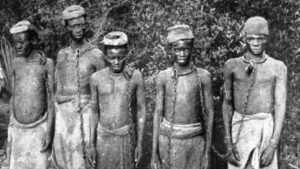
Speaking during a similar occasion last year, El-Enany’s predecessor, Ms Audrey Azoulay, said, “Between the 16th and 19th centuries, around 27 million Africans were forcibly removed from their homes and shipped across the Atlantic and elsewhere.
Only 7.4 million arrived at their destination, where they were objectified, exploited and abused, their labour being given greater value in the eyes of the slavers than their lives.”
Continuing, she said, “This International Day is intended to inscribe the tragedy of the slave trade in the memory of all peoples. In accordance with the goals of the intercultural project… it should offer an opportunity for collective consideration of the historic causes, the methods and the consequences of this tragedy, and for an analysis of the interactions to which it has given rise between Africa, Europe, the Americas and the Caribbean.”
From the above description of the slave trade, by the senior UN official, slavery, whether Transatlantic, Arabic or the modern-day version, is too grave a crime to be classified as “a cultural project.” Such an institutionalized crime must carry commensurate consequences, including reparations or reparatory justice.
Some 20 years ago (April 2007), in an article to commemorate 200 years of the official abolition of the Transatlantic Slave Trade in 1807, we strongly argued that sorrow, condemnation and not even mere acknowledgement will suffice to bring closure to the criminal enterprise that involved the Church of England, the Monarchy, parliamentarians, British and American companies.
The rebellion by slaves in Saint-Domingue, present-day Haiti, on 22-23 August 1791 played a crucial role in the abolition of the Transatlantic slave trade. Ironically, Haiti, the first Black nation to become a republic in 1804, has never known peace or recovered from the debt peonage France imposed on it.
Haiti’s case may seem very dramatic, yet it is a metaphor for what has become the lot of Africa, from where millions of men and women were uprooted and shipped like commodities into forced labour in sugarcane, cotton, tobacco and rice plantations in the Americas and the Caribbean by European slavers.
Instituted in 1998 by UNESCO, the International Day for the Remembrance of the Slave Trade and its Abolition was first celebrated in several countries, notably Haiti (1998) and Gorée Island in Senegal (1999).
It is well-documented that profits from the slave trade financed the British Industrial Revolution and the first industrialisation of the United States. Modern Bristol, Leeds, Liverpool, London and Glasgow owe their opulence largely to wealth from the slave trade.
Former Archbishop of Canterbury, Rowan Williams, is on record as describing the slave trade as “an offence to human dignity and freedom… the greatest cause of grief to God’s spirit.”
“We, who are the heirs of the slave-owning and slave-trading nations of the past, have to face the fact that our historic prosperity was built in large part on this atrocity,” said the former head of the Anglican Church. “Those who are the heirs of the communities ravaged by the slave trade know very well that much of their present suffering and struggling is the result of centuries of abuse.”
Beyond the lamentations or the symbolic remembrance of the slave trade and commemoration of its abolition, calls for reparations are usually dismissed on very flimsy excuses, coupled with the lack of a concerted African leadership to push or drive the campaign.
Some ill-informed commentators and revisionists even try to shift the blame for slavery atrocities to African Kings/Chiefs; they accuse them of selling their own people to foreigners.
While a few misguided chiefs or community leaders might have engaged in the obnoxious trade, they never shipped any slaves abroad. Also, in terms of the benefits, organisation and structure of the slave trade, the mirrors, salt and perhaps gunpowder received by the chiefs will pale into insignificance compared to the huge wealth amassed by the slavers. Furthermore, after the abolition of the slave trade, slave owners were compensated for giving up their chattel. The UK alone paid slave owners the equivalent of more than US$21bn (£16bn) in today’s money.
Until recently, and for unexplained reasons, African efforts on slavery restitution have been episodic and largely uncoordinated.
In contrast, and to their credit, in 2013, the Heads of Government of the 15-nation Caribbean Community (CARICOM), established the CARICOM Reparations Commission (CRC), with a 10-point plan and a “mandate to prepare the case for reparatory justice for the region’s indigenous and African descendant communities who are the victims of crimes against Humanity (CAH) in the forms of genocide, slavery, slave trading, and racial apartheid.”
The 10-point plan calls for: a full apology for the slave trade; reparation; establishment of an indigenous people’s development programme; cultural institutions, such as museums and research centres for the understanding of CAH.
The other demands are to address the public health crisis in the region, illiteracy eradication; establishment of an African knowledge programme; psychological rehabilitation of Africans and their descendants affected by slavery, technology transfer; and debt cancellation.
These are legitimate demands given the enormous losses incurred by the enslaved countries and the gains that accrued to slavers from the slave trade.
A report co-authored by a United Nations Judge, Patrick Robinson, recommended in 2023 that the UK alone should pay US$24 trillion (£18.8 trillion) for its slavery involvement in 14 countries. According to the judge, the sum was an “underestimation” of the damage caused by the slave trade.
However, successive British governments and other countries implicated in the ignoble trade continue to deny responsibility, let alone reparations.
Yet, in the same world that touts justice and equality, survivors of the Holocaust in Israel have continued to receive compensation more than 70 years after the event.
In September 2022, the organisation that handles claims on behalf of Jews who suffered under the Nazis said: “Germany agreed to pay approximately US$1.2bn (euros) to Holocaust survivors living around the world in 2023, bringing its total compensation to more than 80 billion euros.”
The announcement coincided with the 70th anniversary of the signing of the “Luxembourg Agreements, a reparations pact that made it possible for Holocaust survivors to receive a measure of justice for the Nazi persecution of Jews during World War II.”
Fast forward to October 2024, when Israel announced that Germany also agreed to “provide a one-time payment of US$236 (220 euro) to Holocaust survivors, to help them cope with the impacts of the Hamas-led 7 October 2023 attacks in southern Israel.”
This precedent reinforces the fact about who bears the highest responsibility for the slave trade and renders untenable the argument “that those alive today should not be held liable for the crimes of their ancestors.
Holocaust denial or anti-Semitism (hostility to or prejudice against Jewish people) is almost criminalised in Western countries and the United States, which are all today denying restitution for the slave trade.
Is the slave trade being treated differently because Africa is involved?
Even the non-binding UN Resolution A/80/L.48 adopted on 25 March 2026 that declared the slave trade the gravest crime against humanity had 52 abstentions, while three countries – Argentina, Israel, and the United States – voted against it.
But until the countries, governments, institutions and individuals that participated in the enslavement of millions of Africans own up to their responsibility, like Germany continues to do on the Holocaust, the slave trade remains an unfinished business and a major blight on the conscience of the world.
Reparation campaigners in Mother Africa and in the diaspora, especially in the CARICOM, the Americas and the Commonwealth, currently under the leadership of Ghana’s Shirley Botchwey as Secretary-General, have to up their game in strategic synergy and aggressive advocacy to make a compelling case for the slave trade restitution using CARICOM’s 10-point plan as a template.
Ejime is a Global Affairs Analyst and an Independent Consultant on Strategic Governance Communications & Media