
By Chidi Anselm Odinkalu
Of the many vocations known to humanity, few are as rooted in macho masculinity as the military and the law. In tales of both war and law, the advances recorded by women over the past century have been nothing short of remarkable.
In 1970, Pakistan’s ruler was a four-star army general who had fought in World War II. His opposite number in India was a woman whose main claim to the leadership position initially was that she was her father’s daughter.
Yahya Khan was the fifth Commander-in-Chief of Pakistan’s army when public protests forced the then-military ruler, General Ayoub Khan (no relation), to abdicate suddenly in March 1969. As Ayoub Khan’s inheritor, Yahya Khan assumed office as Pakistan’s third president.
Across the border in India, Prime Minister Indra Gandhi had been in office for a little over three years, since being installed in that office on 24 January 1966. She had succeeded Lal Bahadur Shastri, who died suddenly on 11 January 1966, one day after signing the peace treaty to end the first Indo-Pakistan War. Mrs Gandhi’s father, Jawaharlal Nehru, was India’s founding Prime Minister until his death on 27 May 1964.
Both countries were part of the British Raj until separated by an ill-considered partition in the middle of August 1947. The Partition divided the territory into three parts and two countries. Both East and West Pakistan were part of one country. East Pakistan, formerly known as West Bengal, “was separated from West Pakistan by almost 1,000 miles of Indian territory.”
The two Pakistans had extraordinarily little in common other than one faith. The colonial settlement vastly favoured West Pakistan over the East. West Pakistan controlled political power, produced all the rulers since independence, and had an estimated 95% of the officer corps of the military.
In December 1970, Yahya Khan organized an election to transition the country to elective government. The Awami League of Bengali leader Sheikh Mujibur Rahman emerged the clear winner with 169 seats, all won in East Pakistan. Zulfikar Ali Bhutto’s Pakistan Peoples Party was a distant second with 90 seats, all won in West Pakistan. The Pakistan Muslim League won a mere 10 seats, spread across both halves of the country.
It would have been the first time that the east would produce the first leader of post-colonial Pakistan, but Yahya Khan declined to install the winners. Instead, he proclaimed Martial Law and, in March 1971, launched Operation Searchlight, a military action to crush the Awami League and wipe out Bengali nationalism.
As refugees flocked from the unfolding atrocity into India’s state of West Bengal, Prime Minister Indira Gandhi realized she could not be neutral. As Pakistan inched closer to opening a new front with India in its operations in the east, the macho soldier in Yahya Khan eventually found an outlet. On 25 November 1971, he exploded: “If that woman thinks she will cow me, I refuse to take it. If she wants a war, I’ll fight it.”
Prime Minister Gandhi’s riposte was damning: “That woman!”, I am not concerned with the remark….” “That Woman” – the moniker by which PM Indira Gandhi became widely known – eventually defeated General Khan and Pakistan in December 1971. In doing so, she freed East Pakistan from the yolk of the Partition, resulting in the independent country known as Bangladesh.
Like soldiers, the vocation of the law for long did not have a place for “that woman”. Female pioneers in the law were liable to suffer both scorn and rejection.
When the US Supreme Court upheld the decision of Illinois State to deny women the licence to practice law in 1873, it formulated its reasoning in words that Muhammadu Buhari, Nigeria’s president 150 years later, would have been proud of: “The paramount destiny and mission of woman are to fulfill the noble and benign offices of wife and mother. This is the law of the Creator.”
Forty-one years later, the Court of Appeal pretty much upheld the same principle in excluding Gwyneth Bebb, a female graduate of Oxford University, from being licensed as a Solicitor in England.
On the back of developments such as these, the male professional privilege entitlement claimed that “there are no ladies at the Bar.” Like Pakistan’s General Yahya Khan, they lacked the power to see the future.
England produced Eliza Orme as its first female law graduate in 1888, the same year in which Nigeria enrolled Christopher Sapara Williams as its first lawyer.
Yet, it was only after the end of World War I, on Christmas Eve in 1919, that Helena Normanton became the first woman to enter an Inn of Court (Middle Temple) for training to become a barrister. Three years later, in 1922, England enrolled its first female barrister and its first female solicitor respectively.
In 1929, Stella Jane Thomas was admitted to the Middle Temple to begin her professional training as a barrister, having graduated with a degree in law from Oxford University. In May 1933, she was admitted to the Bar in England, becoming the first woman from both Nigeria and West Africa to attain that feat.
Two and a half years later, in October 1935, she became the first woman to enroll at the Bar of Sierra Leone. The following month, she also became the first woman on Nigeria’s roll of lawyers. In 1943, as Stella Jane Marke, she was appointed a Magistrate, becoming Nigeria’s first female judicial officer. She retired as a Chief Magistrate in 1971.
Two years earlier, on 13 November 1969, Modupe Omo-Eboh, the eighth female lawyer produced by Nigeria, also became the country’s first female judge. It would take another 43 years before the country produced its first female Chief Justice in Aloma Mariam Mukhtar.
But resilient glass ceilings remained at the Bar.
In 1976, John Atom-Kpera, military governor of the newly created Anambra State, appointed Victoria Uzoamaka Onejeme the first female Attorney-General in the country.
Sixteen years later, Mrs Priscilla Kuye became the first female president of the Nigerian Bar Association, NBA, succeeding to the vacancy created when the incumbent president, Clement Akpamgbo, a Senior Advocate of Nigeria (SAN), resigned to assume the office of Attorney-General of the Federation and Minister of Justice.
This year, three of the most durable glass ceilings have yielded.
First, in January 2026, Dr Olugbemisola Odusote became the first female Director-General of the Nigerian Law School.
Second, four weeks ago, on 19 July, Oyinkan Badejo-Okusanya was elected president of the NBA. She is the first woman to be declared president-elect of the association.
Then, last Sunday, the country lost it senior-most lawyer. A former Attorney-General of Lagos State, Bandele Alfred Kasunmu, transitioned from law professor to a much sought-after advocate. At the time of his death at 92, Professor Kasunmu had been at the Inner Bar for 46 years.
With his death, the baton of the senior-most lawyer in the country now falls on Mrs Folake Solanke. Admitted to the Nigerian Bar in 1962, Mrs Solanke became a SAN in 1981. She is currently the most senior living holder of that rank.
Of all the attainments in the Nigerian legal profession, this is possibly the most improbable to attain. It requires both distinction and the luck of the Providential draw. The fact that this mantle now falls on a woman is proof positive that, at long last, it is no longer just a man’s bar. Men and women belong in it equally, and women in law are not merely professional cross-dressers or “men in skirts” as it used to be said.
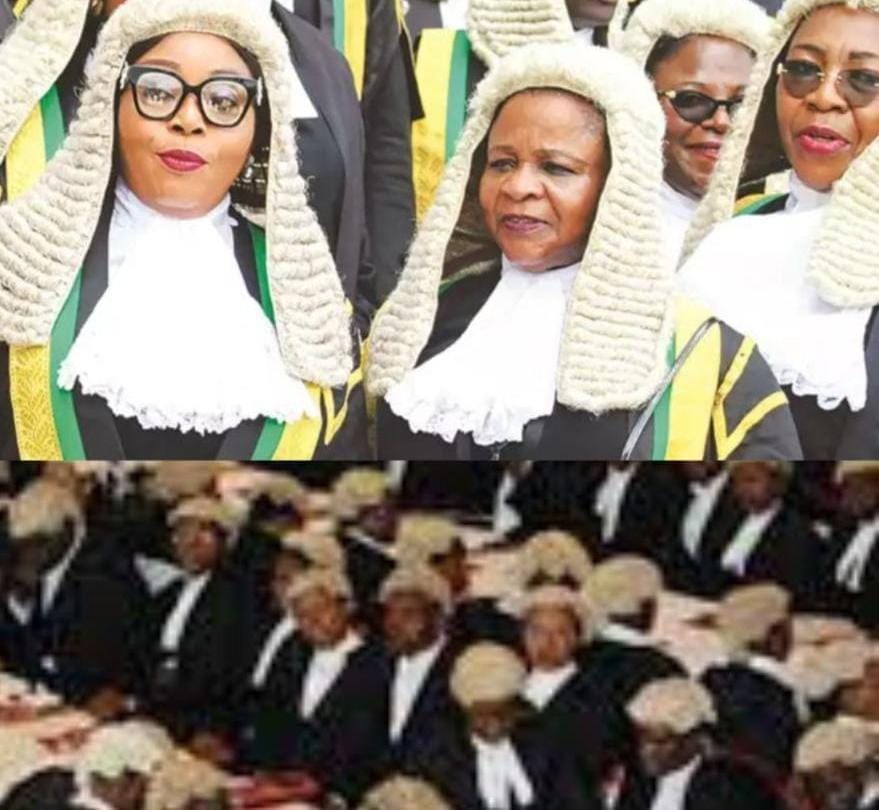
By some coincidence, this year, five of the most important positions in law and justice in Nigeria are now held by women – Chief Justice of Nigeria, the President of the Court of Appeal, the leader of the Body of Senior Advocates of Nigeria, Director-General of the Law School, and President of the NBA.
This could not have been possible without a succession of female pioneers over generations. Obviously, these landmark attainments are not without their own burdens. The women have not arrived here merely to replicate the errors of elite male entitlement. The obligation to continue to raise the bars of both capability and opportunity can only be enhanced – not diminished – by their achievements.
A lawyer and a teacher, Odinkalu can be reached at chidi.odinkalu@tufts.edu