From Edirin Robinson, in Kaduna
The Kaduna State Government, alongside civil society organizations (CSOs) and development partners, has called for collective action and accountability for perpetrators of sexual and gender-based violence (SGBV) across the state.
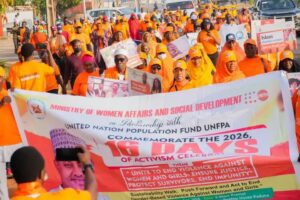
The call was made on Wednesday during a sustainability road walk organized by the Kaduna State Ministry of Women Affairs and Social Development, in collaboration with the CLEEN Foundation, to kick off the 2026 16 Days of Activism Against Gender-Based Violence.

The 16 Days of Activism is a global campaign held annually from November 25, the International Day for the Elimination of Violence Against Women, to December 10, Human Rights Day. It challenges governments, CSOs, and communities to move beyond mere talk and strengthen the systems that protect human dignity.
Held under the theme “Unite to End Violence Against Women and Girls,” the road walk mobilized more than 60 CSOs to march from NEPA Roundabout to Zinger Roundabout and back before concluding at the National Human Rights Commission (NHRC) office on Muhammadu Buhari Way.
Addressing the participants, the Commissioner for Women Affairs and Social Development, Dr. Rabi Salisu, represented by her Senior Special Assistant, Mariam Muazu, emphasized that the campaign must move beyond mere awareness to drive institutional reforms, stronger accountability, and sustainable interventions.
She noted that ending gender-based violence—which includes domestic abuse, rape, child marriage, human trafficking, and economic exploitation—requires a coordinated response from government institutions, traditional and religious leaders, security agencies, families, and communities.
Reiterating Governor Uba Sani’s commitment to protecting women, children, and vulnerable groups, the commissioner disclosed that a major priority is strengthening the four existing Sexual Assault Referral Centers (SARCs) across Kaduna’s three senatorial zones to ensure survivors receive timely medical, psychosocial, and legal care.
She stressed that survivor support must not rely solely on donor funds and called for dedicated government budget lines and institutional ownership to sustain the centers.
On ending impunity, Salisu demanded strict enforcement of the Violence Against Persons (Prohibition) Law and child protection frameworks, warning against shielding offenders because of their social status, family ties, or cultural considerations.
She added that survivors must be protected from stigma, intimidation, and victim-blaming and treated with dignity and confidentiality throughout the justice process.
While acknowledging the support of development partners such as the United Nations Population Fund (UNFPA) and civil society groups, the commissioner urged traditional rulers to challenge harmful cultural practices and called on men and boys to champion respect and nonviolence.
She stressed that fighting gender-based violence is a collective human rights responsibility and urged stakeholders to use the 16-day campaign to build a safer, violence-free Kaduna State.
Emphasizing the call for synergy across relevant ministries, departments, and agencies (MDAs), the Executive Director of the Center for the Study and Resolution of Domestic Violence (CERSDOV), Professor Hauwa’u E. Yusuf, warned that advocacy must expand to address online abuse alongside physical violence.
She reiterated that her organization would never tolerate injustice against the girl child, the boy child, or any citizen. She urged residents to actively engage with the interventions planned throughout the 16 days so that every survivor could access redress, regardless of where the violation occurred.
To turn those commitments into practical support, the Kaduna State Ministry of Justice announced it had established a dedicated Sexual and Gender-Based Violence (SGBV) Unit within its Department of Citizens’ Rights.
Representing the Attorney General and Commissioner for Justice, James Kanyip, the Director of Citizens’ Rights, Amina Aliyu, noted that the unit provides a welcoming, confidential first point of contact for survivors who are frequently deterred from pursuing justice by the fear and social stigma associated with walking directly into a police station.
“Sometimes, a lot of people, when you say they have to go to the police, will refuse, and then the matter dies.
“But if you know that there is an amiable office willing to listen to you without any stigma, then I am sure our people will come,” Aliyu said.
Rather than leaving survivors to deal with legal and medical issues alone, the new unit operates within an integrated referral pathway linking the police gender unit, the Ministry of Human Services, the Federal Neuro-Psychiatric Hospital, and Sexual Assault Referral Centers (SARCs). Cases requiring criminal investigation are formally referred to the police before returning to the Ministry of Justice for prosecution, ensuring continuity from initial disclosure to courtroom accountability.
Welcoming the coalition at the end of the march, the Kaduna State Coordinator of the NHRC, Dr. Tengu Gwar, stressed that eliminating the culture of impunity remains the single most critical factor in curbing gender-based violence.
He added that the massive turnout of state institutions and grassroots groups signaled a shared resolve to protect vulnerable populations and transform Kaduna State into a haven where women and girls can live free from fear.