From Edirin Robinson, in Kaduna
At the stroke of midnight when most of Kaduna slept, Alheri Bulus was battling for her life. Her pained cries shattered the silence that rested on Tsamiya village.
Alheri felt heavy, not just from labour pangs but fear. In a community that lacked a healthcare facility, surviving the night would be a miracle.
Their only means of transportation was an old bike owned by a neighbor which had to journey through a jagged path that served as the only access road outside the community.
Her husband, Tanko Bulus held her on the bike while Sunday, the kind neighbor, did his best to hasten up.
An hour later, when the bike raced into the hospital premises, only a cold body and two broken men welcomed the nurses. Two lives were lost, not by accident or natural causes, but from neglected rights.
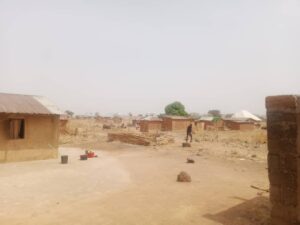
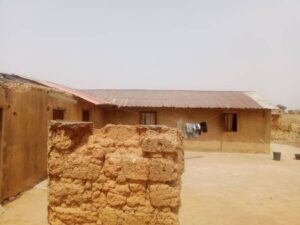
In Tsamiya lies a community, 100 years old, existing between two power houses —the Nigeria Air Force Base, and the Nigeria Defense Academy, yet lacked any source of electricity or modern infrastructure. Ungwan Tsamiya is accessible, only to those who can pay a high price for transportation, our reporter found out.
“Madam, Ungwan Tsamiya na 2,500 Naira. Na who dey go there? We no dey go. So, you go charter the Keke make he carry you go.”
This was the response received from the tricycle riders at the gate of the base. As it were, the only option was to walk down to the community for an hour and thirty minutes or more, depending on how fast the feet moves.
The community located at Afaka-Mando ward in Igabi LGA, about 12KM from Kaduna Metropolis, lacks basic infrastructure like access roads, schools, boreholes for potable water, or even a healthcare facility for the well-being of its residents.
The lack of a transformer is perhaps the most symbolic barrier. Without power, the village is forced to retreat into the shadows every evening at sunset.
Life in the Dark: Triple Toll on Health, Economy, and Education
Celina Ishiaku, a wife and a mother of two, shared her difficult experience in purchasing necessities such as foodstuffs.
“If I am
to purchase any quantity foodstuff, I will spend 1,000 naira on transport alone. The money is not the only issue, the time to get to a shop outside is another issue because we don’t easily get Keke to take us outside.
“Because of how difficult it is, we decided to buy things together. Different families will contribute money and give to one person to go and buy the items. Or you can plenty food stuff and keep if there’s money,” she explained.
Light is power
From classrooms to business centers, it makes room for innovation, safety, and the basic dignity of modern existence.
Without electricity in Tsamiya, small-scale businesses such as tailoring and provision shops are impossible to run. Even a simple haircut requires residents to journey outside.
The only proof of modernization are the phones and bikes very few residents own, and the solar batteries in very few houses.
One of the community youths, Philemon Yakubu, lamented that residents have to pay extra costs for basic needs. According to him, charging a phone or buying a cold drink involves transportation costs and service fees to outsiders which is no gain to them.
“We farm very well here but we cannot keep most of it. Perishable goods must be sold immediately, even at lower prices, or it will start to spoil except for potatoes and others.
“We don’t have fridge or television or anything that need electricity to work. I was born here and that is how this place has been, nothing has changed,” he said.
Until recently, security was also an issue. John David, the community leader disclosed that, his sister and eight others from the community were once abducted, and held captive until a ransom was paid.
To prevent a second occurrence, the road connecting to the central parts of Mando was totally blocked by NAF, a move that has secured the community for a long time.
But while this helped, it brought an issue of accessibility. Ever since, the residents have had to go through the Airforce base to get to other parts of Mando area.
The absence of a clinic or pharmacy turns a medical emergency into a death sentence as residents become vulnerable to preventable illnesses and diseases.
Medical crises often occur at night, and without streetlights or indoor lighting, basic first aid is almost impossible. The transportation of patients on motorcycles through the dark increases trauma and mortality rates.
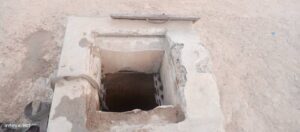
The residents rely on hand-dug wells for water for various purposes. According to the community leader, the water is sometimes dirty which can lead to waterborne diseases, further straining the physical and financial health of the residents.
“Government officials visited us around 2016 for an initiatives program. They met me at home and asked about our problems,” John disclosed.
He added; “I told them we don’t have lights or water. They told me they would come back to provide a borehole because well water is not good for our health, but since then, nobody has visited us again.”
There’s also the issue of Maternal-Child healthcare. Celina disclosed that very few women go for antenatal when pregnant. They depend on shared knowledge of child birth, and visit the hospital only when it’s close to delivery date.
“Some of us don’t go for antenatal. We used to have an old woman who attends to us. She’s like a midwife, and has the experience, so, she takes delivery of the babies. We only visit the hospital when it becomes necessary,” Celina admitted.
Sadly, Mama is late, leaving pregnant mothers to battle with healthcare costs that frightens them. For poor families in Tsamiya, affording medical bills is one thing and accessing medical care is a struggle of its own.
As a source of livelihood, the men engage in menial jobs while the women engage in selling of firewood and ch
arcoals, some do menial jobs like laundry in households.
Very few residents earn salaries. Like John, they depend on small contracts where they are paid after the job is done.
The children are not left out of the struggle. Every school day, pupils and students in the community journey for miles to access education. Community leaders like John, and the Pst. Matthew Samson disclosed that, they spend thousands daily, to support school children for transportation alone.
For Children in Tsamiya community, school day ends when the sun sets. Without light, homework and evening studies are restricted, leading to lower academic performance.
After two years in the community, Pst. Matthew Zarmai made an effort to hold special lessons for the children but the idea is far from progress.
Children without transport fare walk for hours to get to school, and when they make it back home, their bodies feel like logs of wood while their souls feel like giving up.
Peace Yusuf, a secondary school graduate, expressed her desire to leave the community as she feels limited. She says going to school was never easy for her, children had to walk miles, or take lifts from strangers to get to school.
She hopes to study mass communication and become a Reporter. Sadly, Peace has to pause her study plans as her parents are unable to sponsor her tertiary education. She, however, hopes for a scholarship or sponsorship to achieve her dreams.
How Lack of Infrastructure Becomes a Breach of Rights
The lack of infrastructure in rural communities like Tsamiya, does not only limit and reduce the standard of living; it diminishes their worth as citizens of a democratic country —they are exempted from enjoying the dividends of democracy. This breaches several rights including:
The Right to Education: Section 18 of the 1999 Constitution mandates that the Government shall ensure equal and adequate educational opportunities. However, in Tsamiya, Education is not free or accessible when a child must trek for miles or when parents must pay 1,000 Naira daily just to reach a learning environment.
The Right to Development: Article 22 of the African Charter on Human and Peoples’ Rights states: All peoples shall have the right to their economic, social and cultural development.
Electricity is not just a utility; it’s a fundamental right, and the absence of good Infrastructure such as access roads, schools, clinics, is a breach of the right to development.
The Right to Healthcare: The Constitutional Pillar: Section 17(3)(d) mandates that the state ensures there are adequate medical and health facilities for all persons.
But in Tsamiya, healthcare is currently a luxury. When miscarriages happen on the back of a motorcycle because the village has no clinic, the right to health has been violated.
A Community’s Plea for Inclusive Progress
Modernity is not just having the latest gadget; it is the integration of a human being into a functioning, powered, and protected society. Without a transformer or any infrastructure, a community is pre-modern in a nation that is advancing.
They live beside power houses but have no security from the dark. On one side, children walk miles to access education, adults journey far to access basic amenities while on the other, the state functions in full color and high voltage.
While the rest of Nigeria moves toward a digital future, the 250 households here are stuck in a community without light. For John David, this tragedy is not just an incident.
Having lost about three babies to inaccessible healthcare, it is a recurring nightmare etched in the memory of his people.
“Sometimes, before she will even reach the hospital, the baby is already dead. The woman will go unconscious. Like my own, it took her months before she got herself” he lamented.
The community he leads remain stagnant as most residents seek relocation to access conducive environments with better opportunities. Young girls and boys picture school especially at tertiary level as a means of escape from their harsh reality.
“It is sounding as if we are not even part of the government meanwhile, we cast our votes even though we have to go to other wards,” John added.
Their plea remains simple; they are not asking for a favor but for a fair share in the dividends of democracy; the very rights given to them as citizens of Kaduna State.
“We need the government to help us with transformer, boreholes, and other things. We are all Nigerians and we want to live and move together.
“This community has existed for over 100 years. This is where we were born; this is our heritage since the time of our grandparents. We don’t have any other place, and we will not lose hope until change comes,” he said.