Citizenship News
Arab Gulf nations have been watching nervously as neighbouring Iran has been engulfed in nationwide protests.
United States President Donald Trump has threatened military action against Tehran – a move many Gulf powers fear would plunge the region into chaos.
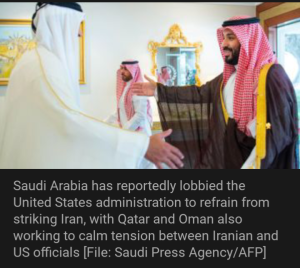
Behind the scenes, Saudi Arabia has reportedly been lobbying the US administration to refrain from striking Iran, while Qatar and Oman have been focused on diplomatic outreach between Iranian and American officials.
The three countries shifted into high-gear diplomacy to de-escalate tensions after reports on Wednesday suggested that contact between Washington and Tehran had broken down, raising fears that an attack was imminent, observers said.
“They were all concerned because all traditional channels [between the US and Iran] were not being utilised, at least from the US side,” said Anna Jacobs Khalaf, a Gulf analyst and non-resident fellow at the Arab Gulf States Institute.
“GCC [Gulf Cooperation Council] officials didn’t know what the US intentions were,” said Muhanad Seloom, assistant professor in critical security studies at the Doha Institute for Graduate Studies.
Regional spillover
Tensions escalated after Trump repeatedly threatened military action in Iran over the bloodshed taking place there. Authorities in Iran say that more than 100 security force personnel have been killed in clashes with protesters, while opposition activists say the real toll includes more than 1,000 protesters, since demonstrations erupted in late December. Al Jazeera cannot independently verify these figures.
Trump called on Iranians to take over state institutions, promising that “help is on the way”.
While it wasn’t clear what kind of attack he was considering, his remarks left the region bracing for an escalation.
Arab Gulf nations fear that a military strike on Iran could disrupt oil prices, shatter their reputation as safe havens for business, and trigger an Iranian retaliation on their soil.
It wouldn’t be the first time. In 2019, Iran-backed Houthis in Yemen struck Saudi Arabia’s oil facilities, temporarily reducing Saudi oil production.
Last June, Tehran attacked Qatar’s Al Udeid airbase, which hosts American troops, after the US struck a key nuclear facility in Iran.
Iran gave ample warning that it would carry out the attack, which marked the end of the 12-day war between Israel and Iran, yet it created a precedent.
And while that conflict weakened Iran’s military capabilities, the Islamic Republic still has an arsenal to hurt US interests in the region.
“Iran has ballistic missiles, supersonic missiles and militia groups around, so if they are given a reason to hit, they would,” said Seloom.
On Wednesday, a senior Iranian official told Reuters that Tehran had warned regional countries, from Saudi Arabia and the United Arab Emirates to Turkiye, that US bases in those nations would be attacked if the US targets Iran.
That was followed by the drawdown of some personnel from the Al Udeid airbase.
Speaking to reporters in the White House later on Wednesday, Trump said he had received information that “the killing in Iran is stopping, is stopped … and there’s no plan for executions”.
While some interpreted that as an off-ramp to de-escalation, the US president did not rule out military action.
Unintended consequences
Each member of the Gulf Cooperation Council has a different history with Iran but they all fear what would happen next and who would fill the vacuum should Supreme Leader Ali Khamenei be replaced or the whole system abruptly collapse, experts say.
The collapse of Iraq following the 2003 US-led invasion, and the chaos that followed – including a deadly civil war, the strengthening of al-Qaeda, and the eventual emergence of ISIL (ISIS) – is an experience Arab Gulf countries do not want to see repeated in a country with a population of more than 90 million, an arsenal of weapons at its disposal, and a badly weakened yet existent network of allies in the region.
“They may like to see the Iranian leadership weakened, but all of them are more concerned about a scenario of chaos and uncertainty and the possibility of more radical elements coming to power there,” said Khalaf.
Qatar, Kuwait and Oman have found their way to exist with their neighbour on the northern shore of the Gulf – Doha even shares with Tehran the world’s largest natural gas reservoir.
The UAE’s Dubai is also a key port for trade with Iran and the two countries enjoy a robust economic partnership.
The UAE would therefore greatly suffer from unrest in Iran or an attack on its soil.
Still, Emirati officials have remained silent in the past week having diverged from other GCC countries by cozying up to Israel and taking different positions in Sudan and Yemen.
Saudi Arabia and Iran have long been arch-foes, but in recent years the rivalry has morphed into a pragmatic relationship based on keeping channels of communication open and preventing each other from escalation.
Riyadh is especially wary of regional destabilisation as the Kingdom embarks on a series of ambitious economic reforms to diversify its reliance on oil and boost its tourism sector – goals that require stability at home and in the broader region.
“Saudi [Arabia] is not comfortable at all with regime change anywhere – it’s radical and extreme and outcomes are uncertain and risky,” Khalaf added.
“Our goal is to achieve stability and calm so that we can direct our resources toward building a better future for our people,” Saudi Arabia’s Minister of State for Foreign Affairs Adel Al-Jubeir said on Thursday.
Still, Khaled Batarfi, a Saudi political analyst, said that Riyadh would welcome changes in Iran, especially if they are gradual, bringing about a leadership willing to curtail its nuclear and missile programmes and one that is less opposed to the US.
“But a sudden change like a regime change with the risk of the country’s disintegration is not going to be good for anyone,” said Batarfi.
“The whole region is on fire and we don’t need to add another fire to our doors.”
(With Al Jazeera)