From Femi Mustapha, in Kaduna
The Executive Director of the African Network for Environment and Economic Justice (ANEEJ), Rev. David Ugolor, has expressed deep concern about the massive loss of billions of dollars to Illicit Financial Flows (IFFs) in Nigeria’s mining sector.
According to him, these lost funds could have been used to develop critical infrastructure, such as roads, schools, and hospitals, ultimately benefiting the Nigerian people.
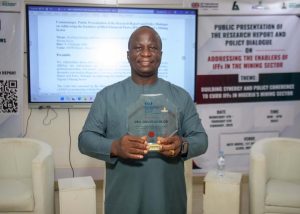
Rev. Ugolor made this assertion while speaking to journalists at a public presentation of a research report on the enablers of illicit financial flows in the sector, organized by ANEEJ in collaboration with the Nigeria Extractive Industries Transparency Initiative (NEITI) and the Federal Ministry of Solid Minerals Development, with support from the Foreign, Commonwealth & Development Office (FCDO).
According to him, IFFs are a significant problem in Nigeria’s extractive sector, particularly in the mining industry.
A new report by Global Financial Integrity (GFI), a United States-based think tank, revealed that Nigeria lost a total of $77.7 billion to trade-related illicit financial flows (IFFs) over 10 years from 2013 to 2022, with most of this occurring in the solid minerals sector.
the
Similarly, the African Union estimates indicate that Nigeria accounts for 35% of Africa’s total illicit financial flows, with 93% of these flows occurring through the extractive industry. This has resulted in a loss for the country, hindering its economic growth and development.
The ANEEJ Executive Director stressed that the mining sector is particularly vulnerable to IFFs, with standard practices including underreporting of exports, tax evasion, and weak oversight.
Rev. Ugolor emphasized that addressing IFFs requires stronger asset recovery measures, robust legal frameworks, and active civil society oversight.
He disclosed that in response to this issue, the Federal Government and the Ministry of Solid Minerals Development are taking steps to check IFFs in the mining sector.
Similarly, he said NEITI has vowed to work with stakeholders to combat illicit financial flows, emphasizing the need for targeted policy reforms, strengthened interagency collaboration, and improved data systems.
The Nigerian Financial Intelligence Unit (NFIU) has also established an Extractive and Environmental Crimes Section to generate proactive intelligence and support investigations into offenses linked to illegal mining, corruption, tax evasion, and environmental crimes.
Furthermore, the Federal Government has committed to implementing the 2023 EITI Standard, which places greater emphasis on addressing corruption risks and IFFs in extractive industries.
This includes enhancing transparency across the entire extractive value chain, including license allocation, beneficial ownership disclosure, production and export data, revenue collection, and interagency data sharing.
Stakeholders at the engagement are advocating for the integration of data systems across key institutions, including the Nigeria Customs Service, Federal Inland Revenue Service, and Central Bank of Nigeria. This would enhance the government’s capacity to monitor production volumes, track exports, and block illicit transactions.
Rev. Ugolor disclosed that addressing IFFs in Nigeria’s mining sector requires a multifaceted approach, noting that the issue must be tackled from different angles.
The event highlighted the need for stronger regulatory frameworks, improved transparency, and increased collaboration among stakeholders to combat IFFs in Nigeria’s mining sector.
He stressed that the research report presented at the event provides empirical evidence of the extent of IFFs in Nigeria’s mining sector and offers recommendations for addressing the issue.
ANEEJ and its partners are calling on the government to take concrete steps to implement the recommendations of the research report and ensure that the country’s mineral resources are managed transparently and accountably.
The fight against IFFs in Nigeria’s mining sector is a collective responsibility, and all stakeholders must work together to ensure that the country’s resources are utilized for the benefit of all Nigerians.