From Edirin Robinson, in Kaduna
Government officials, international development partners, and civil society leaders have called for sustained domestic funding, timely budget releases, and stronger private-sector partnerships to tackle malnutrition and accelerate human capital development in Kaduna State.
The call was the high point of deliberations at the maiden Kaduna State Nutrition Investment Summit 2026, held at the Muhammadu Buhari Hall, Galaxy Mall, Kaduna, on Tuesday under the theme, “Investing in Nutrition, Securing the Future: Mobilizing Sustainable Financing for Human Capital Development.”
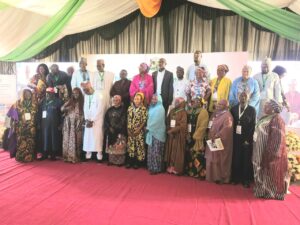
Delivering remarks on behalf of Governor Uba Sani, the Deputy Governor of Kaduna State, Dr. Hadiza Sabuwa Balarabe, stressed that nutrition extends beyond the health sector; it is a foundational pillar of economic productivity and human capital development.
Dr. Balarabe noted that while the state administration has maintained a 15 percent budgetary allocation over the past three years in alignment with its SUSTAIN Agenda, financial commitments must translate to measurable impact at the household level.
“Our sustained budgetary allocation of percent in the past three years will amount to nothing if it does not translate to improved outcomes at households and community levels.
“Our ultimate measure of success must be the number of children saved from malnutrition, the number of mothers receiving adequate nutritional support, and the number of families with access to nutritious food and essential nutrition services,” she explained.
Citing findings from the 2023–2024 Nigeria Demographic and Health Survey (NDHS), the Deputy Governor acknowledged that approximately 4 percent of children under five in the state are stunted, 2 percent are wasted, and 1 percent are underweight.
She, therefore, urged participants to move beyond policy declarations toward transparent, multisectoral action and innovative financing arrangements.
Also speaking at the summit, the Chief of Field Office, UNICEF Kaduna, Dr. Gerida Birukila, who was represented by the Officer-in-Charge, Dr. Idris Baba, commended the state government for its recent efforts, including an investment of approximately US$540,000 in nutrition supplies through the Child Nutrition Fund between 2024 and 2025, which UNICEF matched dollar for dollar.
Dr. Birukila noted that while stunting in Kaduna has declined from 50 percent in 2018 to roughly 50 percent in the 2026 SMART survey, about 110,000 children under five remain acutely malnourished, and approved nutrition budgets often suffer from delayed or incomplete releases.
UNICEF tasked stakeholders to leave the summit with three key commitments: ensuring the full release of approved nutrition budgets, ring-fencing dedicated nutrition budget lines across all 23 Local Government Areas (LGAs), and mobilizing private-sector and philanthropic co-financing for priority nutrition commodities.
Calling for private-sector involvement, the Chairperson of the National Steering Committee of the Civil Society Scaling-Up Nutrition in Nigeria (CS-SUNN), Jessica Bartholomew, lauded Kaduna State for transitioning from high malnutrition burdens a decade ago to establishing a House of Assembly Committee on Food and Nutrition, a Multisectoral Plan of Action, and billions in nutrition allocations.
“His Excellency has also doubled the efforts. And today, we have close to five billion naira allocated for nutrition in Kaduna State. Now, all these efforts are as a result of pure passion and commitment to ending malnutrition in Kaduna State.
“CS-SUNN has been a driver of advocacy, pushing our government to support and see how to scale up nutrition interventions that will reduce malnutrition.”
Jessica emphasized that bringing together traditional leaders, philanthropists, civil society, and the private sector was key to scaling up existing commitments toward a target of over ₦10 billion in nutrition investments to curb malnutrition in the state.
On his part, the Executive Secretary of the Kaduna State Primary Health Care Board, Prof. Bello Jalo, warned that malnutrition undermines public health interventions, including routine immunization programs.
He explained that rates of anemia in malnourished children under five and pregnant women are more than double those of well-nourished people, adding that malnourished children often fail to respond well to life-saving vaccines.
“Today, Your Excellency, having this commitment at the government house level, at the level of planning and budget, at the House of Assembly, at local government, other MDAs downstream the ministries of health, agriculture and education, is a pleasure.
“Let us hope that this renewed conversation aims at having an accelerated, more expanded investment in nutrition.”
He expressed optimism that renewed multi-agency funding, alongside complementary initiatives such as Project MIND, would significantly reduce malnutrition-related diseases across the state.