From Edirin Robinson in Kaduna
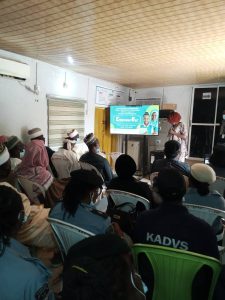
The Empowering Women for Excellence Initiative (EWEI), with the support of Mundo Cooperante, has convened a diverse group of community stakeholders for a one-day training session to secure the fundamental rights of the girl child.
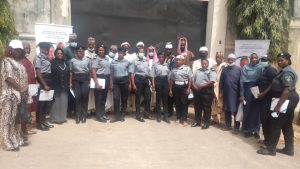
The training, which is part of the EmpowerHer project, brought together security agents from the Kaduna State Vigilance Service (KADVS), traditional rulers, and religious leaders to bridge the critical gap between legal knowledge and actual community implementation.
Launched in October 2025, the EmpowerHer project targets at-risk girls aged 9-16 from Rafinguza, Keke A, and Keke B communities across the Kaduna North and Chikun Local Government Areas, with the specific goal of dismantling the societal structures that sustain female genital mutilation (FGM) and early child marriage.
Despite Nigeria’s evolving legal landscape, girls in many northern communities continue to face discrimination and restrictions on their education. The project addresses these issues by integrating vocational training, technology, and legal support to create sustainable pathways for girls’ empowerment.
Addressing the participants, Program Manager Hafsat Yusuf emphasized that the success of the project relies on localized, domestic access. She explained that the decision to engage female personnel from the Kaduna State Vigilance Service (KADVS) was intentional, as they are positioned to access conservative environments.
“Where we are working is highly conservative, and we don’t want any obstruction. We brought in female security personnel who would be allowed to enter these houses and communities because affected girls are more likely to open up to their female counterparts.
“Next, we are going to enrol these girls. They will work with both in-school and out-of-school girls. So, for those who are out of school, we plan to enrol them again. And then those in school, we are working on keeping them in school by providing for all the basic things they will need to make them stay in school,” she explained.
One of the facilitators, Aisha Abdu Muhammad, the National Publicity Secretary of the International Federation of Women Lawyers (FIDA), highlighted the robust laws available in Kaduna State and internationally.
Aisha lamented that Gender-Based Violence (GBV) remains an abating pandemic due to deep-seated issues like substance abuse, fetish beliefs, and a pervasive sense of impunity. She also observed a significant flaw in the justice system: the tendency for families to shield perpetrators.
“If there’s a case of rape, families often come forward saying they will settle it within the family because they don’t want the survivor to be known,” she explained, stressing that the law cannot work if it is bypassed by domestic silence.
Building on the the Child Protection Law (2018), she noted that the law does not differentiate by gender, and anyone below the age of 18 is a child, and well protected by the law. She called on the Government to enforce strict punishments for perpetrators of crimes against children.
In her session, Girls’ Rights: Human Rights, Fundamentals and the Roles of Community Stakeholders, Nurse Rachel Sankey Daniel from the Salama Sexual Assault Referral Center (SARC) addressed the devastating health consequences of harmful practices to women and girls.
She observed that some complications in childbirth are the result of early pregnancy, asserting that protecting a girl’s health is protecting the future of the lineage. Rachel challenged the stakeholders to move beyond head knowledge of human rights and confront the personal biases that often stall implementation at the community level.
“I focused on four basic rights because, of course, a girl’s rights are human rights. We’re just asking for the basics for the girl child: rights to health, bodily autonomy, right to education, and rights to economic empowerment.”
Attributing the prevalence of GBV cases to harmful practices passed down as tradition, and the greed of enablers who benefit from every dysfunction, Rachel described the advocacy effort as a buffet where everyone—from the government enforcing the power behind the laws to community members looking inward at their own homes—has a vital role to play.
The impact of the training was applauded by Muhammad Tukur, a religious leader from Shehu Jan Mosque in Keke B community, who admitted that the training exposed the sad reality of young girls being sent to hawk day and night rather than attending school.
Viewing the project as a protection for the dignity of young girls, he pledged to carry the message of advocacy back to his colleagues and parents within his community to ensure that education, rather than exploitation, becomes the norm.
Another participant, Inspector Blessing Sunday from KADVS, said the training has boosted her capacity to handle GBV cases using the right tools and channels to protect victims and ensure perpetrators face the law.