
From Femi Mustapha, in Kaduna
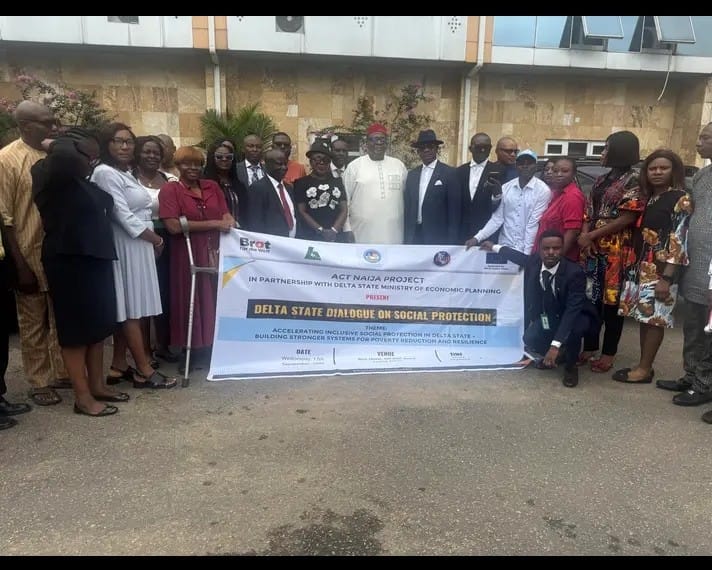
The Delta State Ministry of Economic Planning, in collaboration with the ActNaija Project Consortium, has hosted an important dialogue on social protection in Delta State.
This information was shared in a statement released to the media in Kaduna today.
The statement revealed that the event brought together key stakeholders, including government officials, lawmakers, civil society organizations, media representatives, development partners, and grassroots stakeholders.
Their goal was to assess, align, and strengthen Delta State’s social protection framework.
The Deputy Governor of Delta State, Sir Monday Onyeme, delivered a keynote address reaffirming the state government’s commitment to inclusive governance, resilient systems, and poverty alleviation through social protection initiatives.
He emphasized the necessity of building stronger systems for poverty reduction and resilience, citing various state government programs, including the Delta Community Action for Resilience and Stimulus (D-CARES) and the Widows Welfare Scheme.
The Honourable Commissioner for Economic Planning, Mr. Sonny Ekedayen, highlighted the government’s commitment to fostering a more inclusive and resilient society.
He noted that Delta State has made considerable strides in implementing social protection programs, such as the D-CARES program, the MORE Grant Scheme, and the Widows Welfare Scheme, which have collectively benefited over 266,000 residents across the state.
Rev. David Ugolor, the Executive Director of the Africa Network for Environment and Economic Justice (ANEEJ), stressed the need for a unified and transparent social protection system in Delta State.
He advocated for the signing of the Delta State Social Protection Bill, which is currently awaiting gubernatorial assent, to establish a strong legal framework for harmonizing all social protection efforts across the state.
The dialogue aimed to review the current state of social protection interventions in Delta State, unveil key findings from the ActNaija project baseline study, and strengthen collaboration between the government, civil society, and communities to ensure more inclusive and transparent social protection delivery.
This dialogue is a significant step toward accelerating inclusive social protection in Delta State. By working collaboratively, stakeholders can ensure that social protection programs are effective, efficient, and able to reach those who need them most.
The state government’s dedication to inclusive governance and poverty alleviation is a positive development, and the signing of the Delta State Social Protection Bill would be a crucial step toward achieving this goal.
The event was attended by prominent stakeholders, including the Speaker of the Delta State House of Assembly, Rt. Hon. Emomotimi Guwor, members of the House of Assembly, honorary commissioners, permanent secretaries, and representatives from civil society organizations and development partners.
The collaboration between the government and civil society aims to build a stronger, more inclusive, and resilient Delta State where no one is left behind.
By working together, stakeholders can ensure that social protection programs are effective, efficient, and reach those who need them most, ultimately contributing to a brighter future for Delta State.