By Paul Ibe
Today, I remember Ben, my classmate in secondary school. We had a pet name for him: Expo. He was so dull that even when given an expo, there’s no guarantee that he will pass the examination. Sometimes, the problem is not the absence of answers. It is the inability to understand what has been copied.
President Bola Tinubu has just provided a compelling demonstration of this educational tragedy.
For months, former Vice President Atiku Abubakar has advocated a production-based petrol subsidy: a carefully structured intervention designed to reduce the cost of crude supplied to domestic refineries, make locally refined petrol more affordable, stimulate Nigerian production and ensure that the benefits reach consumers.
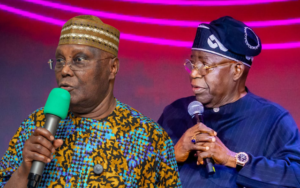
Tinubu and his chorus of economic cheerleaders dismissed the proposal. They called it reckless, economically unsound and a return to the subsidy regime they claimed to have buried in May 2023.
Then came the examination. With Nigerians groaning under increasingly unbearable petrol prices and the 2027 elections approaching, Tinubu suddenly discovered that government intervention to lower fuel prices might not be such a terrible idea after all.
Enter the controversial 30-day NNPC petrol discount.
Atiku, understandably amused by this extraordinary intellectual conversion, compared Tinubu to a student who copied a classmate’s examination answers so blindly that he copied even the classmate’s name written at the top of the answer sheet.
Imagine the scene.
Examination: Economics 2027
Question: How can Nigeria sustainably reduce petrol prices, protect consumers and promote domestic refining?
Candidate One: Atiku Abubakar.
Answer: Introduce a transparent, production-based subsidy that lowers the cost of crude supplied to Nigerian refineries, subject to fiscal limits, independent audits, verifiable domestic supply obligations and mechanisms to pass savings to consumers.
Candidate Two: Bola Tinubu.
Answer: Give a 30-day discount at NNPC filling stations.
Name of Candidate: Atiku Abubakar.
Even the invigilator would be confused. One candidate understood the question and proposed a framework. The other appears to have copied the conclusion, discarded the workings and submitted a supermarket promotion as an economic recovery programme. It is the kind of expo that deserves a refund.
The mathematics of discounted intelligence
Let us examine Tinubu’s celebrated answer. Nigeria has approximately 22,681 registered filling stations, according to figures published by the downstream petroleum regulator in December 2025.
Industry estimates put NNPC Retail’s network at approximately 920 stations at the end of 2024, representing roughly four per cent of that nationwide figure.
NNPC’s estimated share of the petrol and diesel retail market was 17 per cent in 2024.
Even more revealing, NNPC’s own July 2026 operational report recorded PMS availability across its retail stations at just 52 per cent.
These figures are not opposition propaganda. They come from regulatory, industry and NNPC records.
Now consider the examination question.
How does a government intend to provide meaningful nationwide relief across 36 states, the Federal Capital Territory and 774 local government areas through a discount restricted to a retail network representing roughly four per cent of the country’s filling stations?
What happens to Nigerians in communities without an NNPC outlet?
Must the farmer in rural Benue abandon his farm and travel to Makurdi in search of presidential benevolence?
Must the trader in a remote village in Sokoto embark on a journey that consumes more petrol than the discount saves?
And what happens where an NNPC station exists but has no petrol to sell?
Perhaps the discount comes with a complimentary geography examination: locate the nearest participating filling station and explain how you intend to get there.
For the millions of Nigerians outside the convenient reach of NNPC outlets, Tinubu’s intervention risks becoming what Nigerians have dubbed audio relief: plenty of announcements, insufficient benefits.
Subsidy by another name, or 419 mathematics?
The most entertaining part of this examination is the government’s insistence that the arrangement is not a subsidy.
Finance Minister Taiwo Oyedele has gone to considerable lengths to explain that NNPC Retail is merely surrendering its profit margin, and that no money is being taken from the federal budget or Federation Account.
There is a legitimate economic distinction between a retailer foregoing its margin and government paying a budgetary subsidy.
But there is another question that deserves an answer. Who owns NNPC Limited? The company is owned on behalf of the Nigerian federation, with its shares held through the Ministry of Finance Incorporated and the Ministry of Petroleum Incorporated.
Its commercial status does not transform it into somebody’s private petrol station.
If a publicly owned enterprise deliberately foregoes profit, that decision can affect its earnings and potentially the dividends ultimately available to its public shareholders.
This does not automatically establish that treasury money has been spent. But neither does it justify pretending that the financial consequences have absolutely nothing to do with the public.
So, when Nigerians are told that the discount costs them nothing, they are entitled to demand the full arithmetic.
How much revenue is being forgone? What is the expected financial impact? Who approved it? How will the intervention be accounted for?
Otherwise, we are entering the territory of what might be called 419 economics: not an allegation of criminal fraud, but the political art of presenting Nigerians with a gift while leaving them to discover who ultimately paid for the wrapping paper.
The government wants applause for a concession made by a company belonging to the Nigerian people.
That is rather like a landlord announcing that he has generously bought his tenants a new generator, only for the tenants to discover that the purchase was charged to their service account. And then the landlord insists on a standing ovation.
Atiku’s answer versus Tinubu’s expo
The fundamental difference is not merely semantic. It is structural. Atiku’s production-based subsidy seeks to intervene where the cost of petrol begins: domestic refining.
The proposal envisages reducing crude feedstock costs for qualifying Nigerian refineries, tying the benefit to verifiable local production and domestic supply, and ensuring that lower costs translate into lower prices for Nigerians.
It is designed to operate under a defined fiscal ceiling, with safeguards against diversion, abuse and opaque subsidy claims.
Most importantly, its benefits are intended to flow through the broader petroleum distribution system, rather than depend on the ownership of a particular filling station.
Tinubu’s discount, by contrast, operates at the final retail stage, is confined to participating NNPC outlets and is scheduled to expire on October 31.
One proposal addresses the production cost structure. The other temporarily reduces one retailer’s margin.
One seeks a sustainable framework for nationwide affordability. The other offers a limited promotional window.
It is the difference between proposing a treatment for an ailment and distributing painkillers for 30 days while congratulating yourself on curing the patient.
Even a generous examiner would struggle to award both candidates equal marks.
The politics of a discounted conscience
None of this means Nigerians should reject cheaper petrol wherever they can find it. Every naira saved at the pump matters to a struggling household, a commercial driver, a farmer or a small business owner.
But citizens deserve more than temporary favours dressed up as transformational policy. They deserve affordability that is sustainable, accessible and measurable.
They deserve a government that does not ridicule an idea in September, borrow its underlying logic in October and then claim an original discovery.
They deserve relief that is not determined by whether an NNPC filling station happens to be located conveniently along their route. And above all, they deserve answers that survive beyond the next political examination.
Tinubu’s discount may provide some genuine relief. But temporary relief is not synonymous with lasting reform.
The Nigerian economy is not a supermarket where economic hardship can be resolved with a month-end clearance sale.
Nigerians need more than a presidential discount coupon.
The examiner’s verdict
The scripts are now before the Nigerian electorate. Atiku has submitted a production-oriented proposal with an identifiable economic objective, fiscal safeguards and a framework intended to connect domestic refining with consumer affordability.
Tinubu has submitted a temporary retail discount, accompanied by an elaborate argument explaining why the intervention must not be called a subsidy.
Perhaps the most extraordinary thing about this examination is that the candidate who once denounced the answer is now demanding credit for borrowing part of it.
That is not innovation. It is a discounted expo. And the tragedy is that even after receiving the expo, the student still managed to omit the most important parts of the answer.
Fortunately, the examiner is not the APC publicity directorate. It is the Nigerian electorate. In January 2027, Nigerians will have an opportunity to mark both scripts.
My verdict is straightforward. Atiku’s production-based proposal is well ATIKULATED. Tinubu’s 30-day discount is an inadequately copied answer with an expiry date.
The difference between the two is the difference between understanding a question and merely obtaining the expo.
And if there is one lesson Bola should take away from this examination, it is that copying somebody else’s answer is bad enough. Copying it badly, leaving out the workings and still demanding full marks is something else entirely.
Unfortunately, Nigerians cannot afford to keep paying the school fees for such expensive lessons beyond May 29 2027.
Paul Ibe, Media Adviser to Atiku Abubakar, writes from Abuja.