From Edirin Robinson in Kaduna
Kaduna State has launched a transformation in its educational landscape through data-driven planning, digital tracking, and inclusive learning under the $62.8 million Reaching Out-of-School Children (ROOSC) Project.
The Project Coordinator, Ezra Angai, detailed the state’s comprehensive approach to tackling educational exclusion during a media parley held to commemorate the 2026 world literacy day.
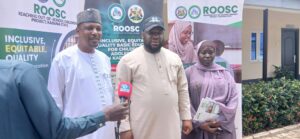
Speaking on the celebration which marks 60 years since its inception in Tehran, Iran, in 1966, Angai noted that while decades of progress have been recorded, global challenges persist.
He cited data from UNESCO, indicating that 739 million people remain illiterate, a disproportionate number of whom are girls and residents of hard-to-reach rural areas.
He opined that modern literacy goes beyond basic reading and writing. “In an era shaped by artificial intelligence, digital systems, and advanced technology, individuals must be equipped with technical, vocational, and 21st-century survival skills.
According to him, this evolution aligns with the core focus of this year’s theme: literacy for people, planets, and prosperity.
Highlighting the national context, Angai acknowledged that Nigeria faces a significant challenge with an estimated 18 million out-of-school children.
He, however, applauded the Federal Ministry of Education, under the leadership of Minister Dr. Tunji Alausa, for pushing robust, data-driven reforms through the Renewed Hope Agenda, including the nationwide deployment of digital census systems.
Significantly, the proeci Coordinator announced that Kaduna State has maintained its pioneering status, becoming the first in the country to capture over 98% of its educational data using the federal digital D-NEMIS platform.
He added that the state continues to back its policy ambitions with strong financial commitments, consistently allocating over 25% of its annual budget to education, well above both national averages and UNESCO guidelines.
The $62.8 million ROOSC project is backed by the Islamic Development Bank, Kuwait Fund for Arab Economic Development, Global Partnership for Education, Education Above All, Save the Children International, and UNICEF.
Angai revealed that the project is anchored on an extensive household mapping exercise.
Covering 360,000 households, the survey successfully identified 187,719 out-of-school children and documented the socioeconomic barriers keeping them away from classrooms.
“The data revealed that over 90% of non-attendance stems from household economic pressures, with roughly 57% of the affected demographic being boys drawn into farming or commercial ventures to support their families.”
To counter this, the four-year project is executing structural interventions, including the construction of 102 new schools, and renovation of 170 others with 42 sites currently active, including 16 new schools.
“There is the integration of traditional Tsangaya schools into formal learning pathways, and the deployment of the Accelerated Basic Education Program (ABEP) for overaged children between the ages of 11 and 17. The programme compresses basic education into two years and six months.”
Emphasizing on equity and inclusion, Angai said the project had also conducted disability assessments with support from SCI and provides targeted support for vulnerable groups, including assistive medical devices and physiotherapy for children with disabilities, menstrual hygiene kits for adolescent girls, and radio-based learning for volatile or hard-to-reach areas.
To guarantee sustainability, the project operates a four-tier monitoring system comprising a digital database; weekly and monthly reviews by SCI, case workers assigned to school clusters, and quarterly joint monitoring involving the Project Management Unit (PMU), State Universal Basic Education Board (SUBEB), Quality Assurance Department, Ministry of Education and development partners.
Disclosing the interest of the Federal Minister of Education in adopting Kaduna’s comprehensive mapping model on a national scale, Angai stressed that, “Every child deserves access to quality and inclusive education.”