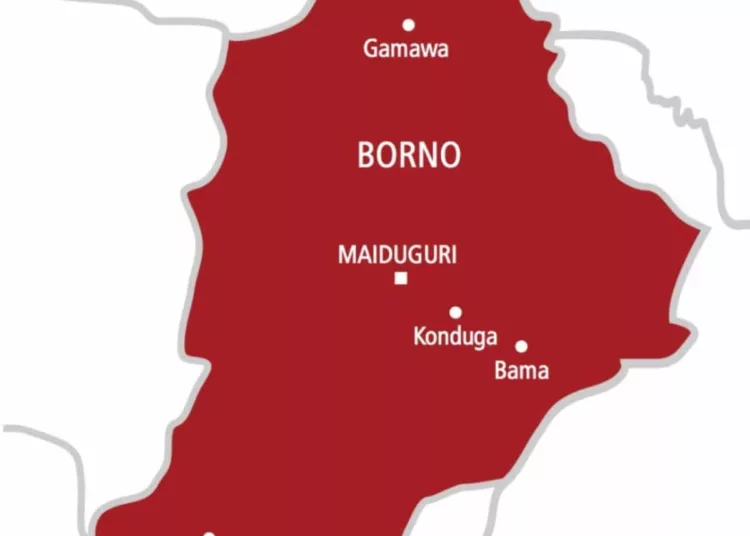

From Uthman Abubakar, in Maiduguri
The Network of Civil Society Organizations Borno State has scolded the Borno State Commissioner for Poverty Alleviation, Youth Empowerment and Sports over his alleged severe threats to those who refuse to vote for the ruling All Progressives Congress (APC) in the forthcoming 2027 elections.
Alhaji Buba Sayinna is alleged to have mouthed the threat during a recent political gathering in Maiduguri.
In an online viral video in circulation, the Commissioner allegedly threatened physical harm specifically declaring that the regime is ready to “cut off” or “break” the fingers of political dissenters while asserting that government welfare benefits will be exclusively for ruling party loyalists, leaving non-supporters to be “flogged.”
Although the Commissioner has subsequently attempted to frame these remarks as figurative political language directed at party internal affairs.
NECSOB unequivocally rejected both the premise and the substance of such rhetoric.
Consequently, the network argues in a press statement, “Section 40 of the 1999 Constitution of the Federal Republic of Nigeria (as amended) guarantees every citizen the fundamental right to freedom of association and political choice.
The statement, signed by the network’s Executive Director, Abubakar Abdullahi Suleiman, continued: “The assertion that public resources, statutory welfare, or democratic participation should be conditioned on political allegiance fundamentally subverts the principles of constitutional governance.’
The network maintains that government welfare is funded by public revenues, not party coffers, and must be administered equitably to all citizens without partisan discrimination.
The network observed that Borno State has endured over a decade of severe security challenges and is currently navigating a fragile process of post-conflict reconstruction, recovery, and peacebuilding.
“As the Cabinet member tasked with Poverty Alleviation, Youth Empowerment and Sports, the Commissioner holds an explicit mandate to foster civic responsibility, peace building, and social harmony and empowerment among young people,” warning, “Deploying violent imagery—whether literal or figurative—threatens to normalize political violence, overheats the polity, and incites youth cadres towards political intolerance ahead of upcoming and fragile electoral cycles.”
The network urges cabinet members, political appointees and all other political parties to exercise maximum restraint in public communications, steering clear of divisive, coercive, or violent language in political engagements. ENDS