
From Femi Mustapha, in Kaduna
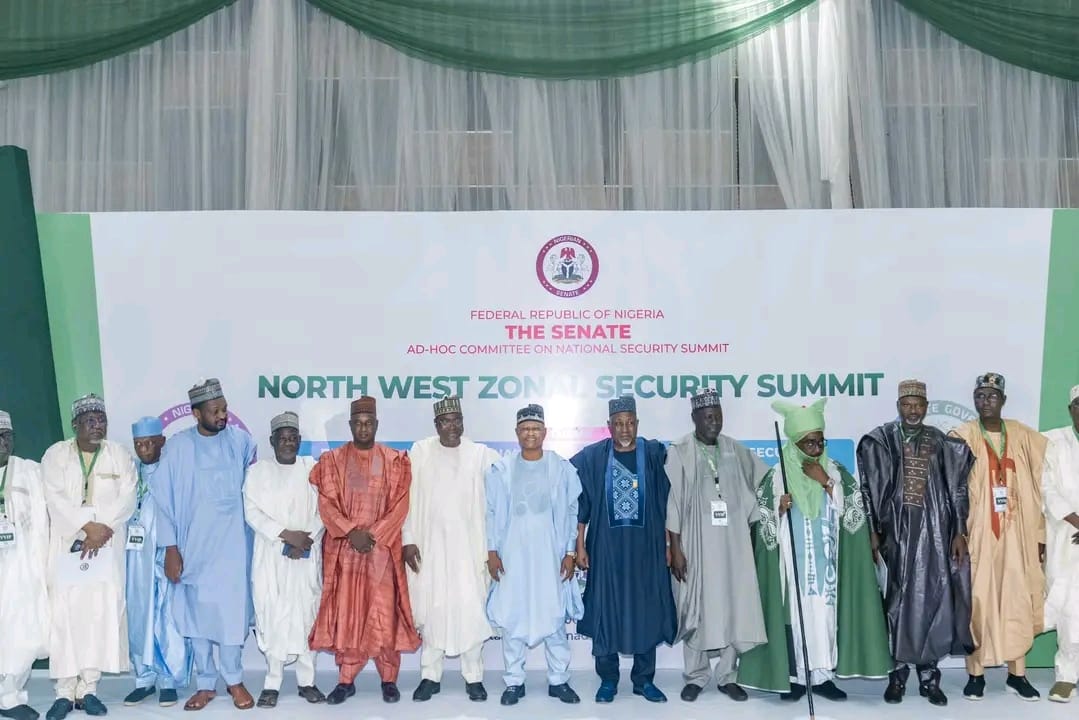
The looming security crisis in Northwest Nigeria took center stage at the Northwest National Zonal Security Summit, held in Kaduna on November 29, 2025.
Organized by the Senate Ad Hoc Committee on National Security under the leadership of Senator Michael Opeyemi Bamidele, CON, the summit aimed to gather governors, security chiefs, traditional leaders, civil society groups, and development partners to confront an unprecedented wave of banditry, jihadist activity, mass displacement, and food insecurity that has overwhelmed individual states.
In a paper titled “Building Robust Regional Collaborations to Tackle Insecurity: Pathways for Securing the Future,” Professor Muhammad Kabir Isa from the Faculty of Administration at Ahmadu Bello University, Zaria, argues that the problems facing the Northwest can no longer be solved by fragmented state responses.
Drawing on the Human Security paradigm, the Collective Security doctrine, Multi-Level Governance (MLG) theory, and the Triple Helix model of government-security-community collaboration, Isa contends that only an institutionalized regional architecture can reverse the trajectory of violence.
The paper cites alarming figures from the Global Centre for the Responsibility to Protect, which recorded 2,266 Nigerians killed by banditry and insurgency in the first half of 2025—surpassing the total for all of 2024.
The International Organization for Migration reported that over 1.3 million internally displaced persons were present across the North-Central and Northwest regions by April 2024, marking a 19% increase from December 2023.
The United Nations Office for the Coordination of Humanitarian Affairs warned that more than 33 million Nigerians could face crisis-level food insecurity during the 2025 lean season, with the Northwest being disproportionately affected.
Field research conducted under the Political Economy and Conflict Assessment for the Federal Ministry of Humanitarian Affairs and Poverty Reduction estimates that around 30,000 armed bandits operate in more than 100 organized gangs across the Northwest.
In Zamfara State alone, approximately 725 villages across 13 local government areas remain effectively under bandit control, while 638 villages have been completely sacked in the past two years.
An analysis by the Soufan Center revealed that the Islamic State West Africa Province (ISWAP) led all global Islamic State “provinces” in attacks between July 2024 and July 2025, with 445 incidents resulting in 1,552 casualties. The emergence of the Lakurawa terrorist organization in 2025 further illustrates the convergence of criminal and jihadist networks.
Isa identifies several interlocking drivers of the crisis: governance deficits and institutional weaknesses, chronic socio-economic distress, livelihood erosion, proliferation of small arms and light weapons, environmental stress, climate change, resource scarcity, weakening of traditional institutions, corruption and informal alliances fueling a conflict economy, an inadequate security architecture, demographic pressures from a youthful population, and a failure of interstate collaboration.
He argues that these factors are mutually reinforcing and cannot be addressed through isolated military operations or piecemeal development projects.
The paper critiques existing responses, noting that while federal military operations have achieved tactical successes, they have not translated into strategic stability as armed groups adapt, relocate, and re-arm. Policing and intelligence remain fragmented, and state-level initiatives are disjointed, allowing bandits to exploit jurisdictional gaps.
Community-based security structures, though valuable, often lack training, resources, and legal backing, rendering them vulnerable to attack.
To overcome these shortcomings, Isa proposes a comprehensive regional security architecture anchored by a Northwest Security Coordination Forum.
This forum would bring together governors, federal security chiefs, traditional rulers, and representatives from civil society.
It would oversee a Joint Intelligence Fusion Platform, a Cross-State Joint Operations Command, harmonized legislation, and the integration of traditional institutions with community-based security actors. Crucially, the framework also calls for integrating development interventions—such as livelihood restoration, education recovery, humanitarian assistance, and justice reforms—into the security strategy, aligning with the Human Security and MLG approaches.
The summit’s theme, “Building Robust Regional Collaborations to Tackle Insecurity: Pathways for Securing the Future,” reflects the urgency of the moment. Senator Bamidele, in his opening remarks, stressed that the region’s stability is a national imperative and that collaborative action is the only viable path forward.
Participants are expected to endorse the proposed regional architecture, commit to joint operations, and pledge resources for intelligence sharing, community engagement, and long-term development.
In the closing session, additional measures will be discussed to ensure the adoption of these recommendations and foster lasting regional cooperation.
Maj. Gen Danjuma Ali Keffi, in his presentation, argued that a _regional security architecture_ must combine three pillars: a joint intelligence fusion platform to break information silos, coordinated cross‑state operations that eliminate safe havens in forest belts, and ( sustained community‑level engagement to prevent the re‑emergence of criminal networks.
He warned that without an institutionalised mechanism, the gains from military raids would remain short‑lived, and called for the establishment of a Northwest Security Coordination Forum to oversee implementation