
By Kelechi Opara, Abuja
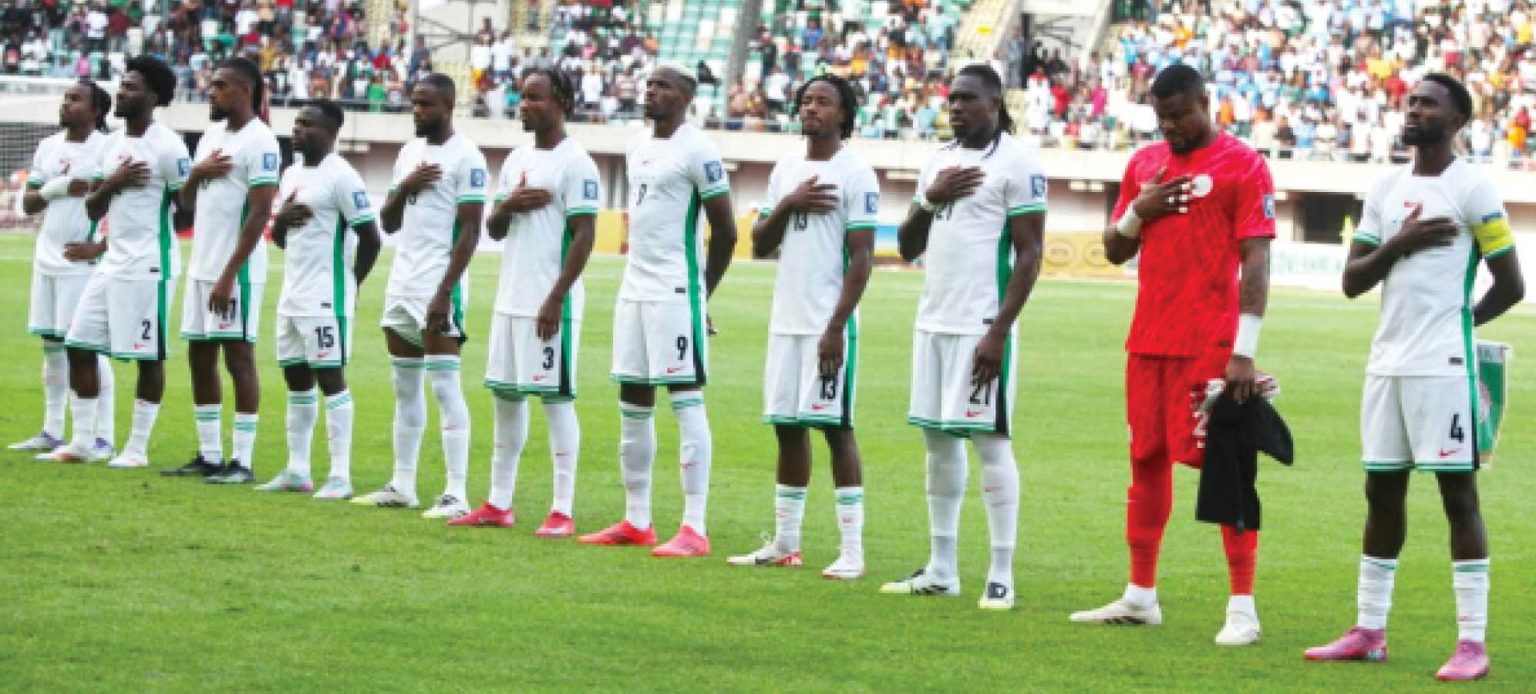
The Lions of Democratic Republic of Congo Sunday night put up a superlative performance to deny the Super Eagles the opportunity of qualifying for the 2026 FIFA World Cup, to be jointly hosted by the United States of America, Mexico and Canada.
The make or mar encounter was part of the playoffs to determine the African team that would represent Africa in the international playoff slated to take place next year ahead of the mundial.
Unfortunately, Nigeria was also unable to have qualified for the last World Cup which took place in Qatar in 2002.
The Super Eagles had missed the chance of an automatic qualification after failing to clinch the Group H ticket, despite competing against the likes of Rwanda, Lesotho, Zimbabwe, Benin and South Africa who eventually topped the group to book their spot for the biggest football tournament.
Anybody who without any bias watched the match between Nigeria and D R Congo will agree with me that the East Africans were more organized, more purposeful and even hungrier than our boys.
Frank Onyekuru had put Nigeria ahead, just with three minutes of play after his strike was deflected into the net by a Congolese defender.
Unfortunately, instead of the Super Eagles mounting more pressure for a dependable second goal, they started showing their inherent weakness which is lack of mobility. They were more defensive and it was obvious that it was only but a matter of time for the Lions to have roared back, and they did in the 32 minute when Meschak Elia took advantage of Captain Wilfred Ndidi’s flat efforts to send goalkeeper, Stanley Nwabali the wrong way.
Even when they were trailing by the loan goal, they were very relaxed in their approach and that saw them controlling the midfield especially in the second half.
The substitution of Victor Osimhen at the end of the first half did not help matters for the Super Eagles because their attack after his exit lacked any bite that could rattle the Congolese defence and their goalkeeper, Lionel Messi who was more on a ‘sabbatical’.
In fact, it was a miracle that the lackluster Super Eagles managed to drag the match into extra time and the resultant penalty shootout.
In the shootout, the poor performance continued when Fulham defender, Calvin Bassey sent his effort over the bar.
Despite the superlative efforts of goalkeeper, Stanley Nwabali who stopped two penalty kicks, the players were unable to convert their kicks, especially Moses Simon who played as if he was in a training session.
Many analysts has cautioned that the level of celebration that went on at the Nigerian camp after the team beat Gabon 3-1 in the first game of the playoffs was uncalled for. They had argued that D R Congo must be taken seriously, given the fact that they eliminated African powerhouse, Cameroon in their first playoff encounter.
But as noted earlier, the bad omen for the Super Eagles started after the Nigeria Football Federation (NFF) sacked Coach Jose Peseiro after the 2024 Africa Cup of Nations where Nigeria placed second behind host nation, Ivory Coast.
Then there was this politics of whom to appoint as many Nigerians believed that the country has qualified and dedicated coaches that can do even better than the foreign managers.
Many names came up, especially the likes of former African Footballer of the Year, Emmanuel Amunike, former Super Eagles winger, Finidi George and NFF technical director, Austin Eguavoen, amongst others.
However, the football authorities chose Finidi George who began the qualification matches with a rather unimpressive result. He played a 1-1 draw with South Africa in Uyo and lost 1-2 to Benin Republic, leaving Nigeria stranded with one point from a possible six.
This development forced the NFF to contemplate hiring a foreign manager to boss George who also worked under Peseiro as his assistant. But the former Heartland FC of Owerri manager threw in the towel, in June 2024.
In January 2025, the NFF named former National coach of Mali, Eric Chelle as the Super Eagles manager. He began by leading Nigeria to a 0-2 victory away against Rwanda, while playing out a 1-1 draw with Zimbabwe in Uyo.
Many people believe that Chelle may have done better after keeping a clean sheets in seven matches without a defeat. But his performance was not good enough to book a place for the country at the global soccer fiesta. He avoided defeats and also played more draws, even with minnows like Lesotho and Zimbabwe.
It is a also instructive to note that there is an urgent need to rebuild the national team. Most of the present crop of players are now surplus for requirement. They are no longer hungry for success. The lackluster performance on Sunday says it all. We need young boys that are really hungry for success. Any coach whether local or foreigner must be ready to start from the scratch to build a team that has the pattern and flare the Super Eagles were known for.
There is another disturbing fact, that the players had to boycott training won arrival at Morocco for the playoffs because of backlog of unpaid allowances.
While the National Sports Commission (NSC) claims that the NFF were given all the funds they needed to settle the players, the NFF is somehow not vocal to dispel this notion.
From the benefit of knowledge, in most cases, when the government claims to have given funds to its affiliates, it could only be the paper approval without any cash backing. Unfortunately for the subordinate body, they will keep mum and take the heat, knowing that there could be further sanctions should they spill the beans.
One thing that is certain is that since presidency of Alhaji Ibrahim Gusau as the NFF boss, he has managed to run the federation professionally without the usual rancour that used to characterize football administration in the country. It’s unfortunate for him that these things are coming out now.
There are also some people who strongly believe that nemesis caused by the previous administrations are following the team. Before now, the NFF has been known for failing to pay allowances and estacodes to deserving Nigerians after using their manifest to collect the money from the government.
Another important issue is that since the federation will be going into an election in 2026, many of those plotting to take over football administration in the country have started scheming to upstage those who are in office. This has been a huge albatross on Nigerian football development.
I have advocated that the elections should be taken away from the world cup years, so as to minimize the noise and distractions that go with every election year.
The present administration can do that by getting the Congress to give the approval probably for a tenure extension of say two years. So in 2028, the board will conduct a credible election that will be rancour free because all those who will be on the board till then should not participate. It’s doable, it only calls for a little sacrifice here and there.
Any keen follower of Nigerian football administration will agree with me that since the era when some stakeholders used toxic politics to oust former Chairman of the then Nigeria Football Association (NFA), Alhaji Ibrahim Galadima, the ghost of that illicit action has continued to hunt our football. Even if they push out those that are there today, nothing will change because the foundation is already faulty.
Finally, since the country is going to participate in the AFCON in Morocco in the coming month, I think Eric Chelle should be allowed to handle the team and if he can’t identify quality and hungry players that will represent this country, he should be given the sack letter for a dedicated Nigerian coach to take over.