International Conference on Financing for Development: ANEEJ harps on Africa-driven reforms
From Femi Mustapha, in Kaduna
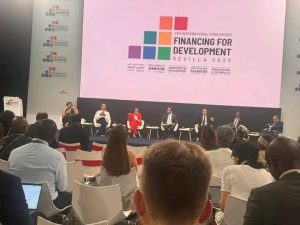
The African Network for Economic and Environmental Justice (ANEEJ) has reaffirmed its leadership in advancing gender-responsive development, and Africa-driven reforms at the 4th International Conference on Financing for Development (FfD4), held in Seville, Spain.
This was contained in a document made available to the media in Kaduna on Tuesday.
The statement stated that the Executive Director of ANEEJ, Rev. David Ugolor, while speaking at the 4th International Conference on Financing for Development (FfD4), held in Seville, Spain, stressed the significance of Beneficial Ownership (BO) reforms for Africa, particularly in addressing the persistent hemorrhaging of public resources through IFFs.
According to him, Africa is losing billions annually through illicit flows, saying BO transparency is a foundational tool in halting this trend.
He further emphasized the need for increased support to African civil society organisations leading advocacy efforts at national and regional levels.
Earlier in his remarks, the Executive Director of Open Ownership, Tom Townsend praised the inclusion of beneficial ownership in the FfD4 Outcome Document as a pivotal achievement, describing the conference as a rare opportunity to galvanize political will and deepen reform momentum.
In his paper presentation titled ‘Equitable Ecological and Development Cooperation as Feminist Justice’, the ANEEJ’s Deputy Executive Director, Mr. Leo Atakpu, called for a transformative approach to climate finance and development policy—one that centers equity, inclusivity, and gender justice, he said.
He expressed concern that the FfD4 Outcome Document fell short in reflecting feminist priorities, warning that failure to integrate feminist concerns is not just a missed opportunity, but it perpetuates structural silence.
His intervention was lauded by participants as a timely and necessary call for intersectional justice in global development financing frameworks.
Speaking at the session, the Vice President of the African Development Bank (AfDB) said “We cannot expect those benefiting from the current system to reform it. Africans must lead the charge in restructuring global financial systems that serve their interests.”
He called for a repackaging of Domestic Resource Mobilization (DRM) strategies to align with Africa’s unique socio-economic realities. He reiterated the need to operationalize the newly adopted UN Framework Convention on International Tax Cooperation as a tool for reform.
Across all engagements, ANEEJ reiterated its unwavering commitment to advancing financial transparency, feminist values, and African ownership of the development agenda.
The organisation’s active presence at FfD4 reinforced its role as a leading voice for civil society in shaping fairer and more accountable global financial systems.
As the world looks beyond FfD4, ANEEJ has positioned itself to continue driving the discourse on inclusive development, anti-corruption, and financial justice on the African continent and beyond
ANEEJ actively engaged in a high-level side meeting hosted by Open Ownership, themed “Where Next on Beneficial Ownership Transparency? The Road Forward from FfD4.”
The session brought together key stakeholders worldwide to discuss the future of beneficial ownership (BO) reforms as a tool to combat illicit financial flows (IFFs) and strengthen global financial integrity.
Supported by leading transparency and anti-corruption organisations—including the FACT Coalition, International Budget Partnership, Tax Justice Network, and Transparency International—the event highlighted the growing global consensus around BO transparency as essential to sustainable development.