
By Paul Ejime
Embattled Guinea-Bissau leader Umaro Sissoco Embaló has “sneaked back” in the country after the 26 November military coup, which he is believed to have stage-managed, with an anti-coup protest planned on Friday, 12 December, diplomatic sources said in Bissau.
“We understand he (Embaló) is back, hiding somewhere in the country and controlling his loyalists in power,” said the sources on condition of anonymity.
Embaló, who has been ruling Guinea-Bissau with an iron fist for the past five years, announced he had been toppled by military officers, a day before the National Electoral Commission, CNE, was to announce the results of the country’s 23 November parliamentary and presidential elections.
The military group that seized power and the 28-member cabinet it announced, comprise mainly Embaló loyalists, including the junta leader or Transitional President Gen. Horta Inta-A, and the new Prime Minister Ilídio Vieira Té, who was his Campaign Director during the 23 November elections.
After the coup, Embaló was evacuated from Bissau to Dakar with a special flight arranged by the Senegalese President Diomaye Faye, who is believed to be supporting him, even when other ECOWAS leaders are canvassing a hard line measures against the strange coup.
The Guinea-Bissau leader is accused of instigating disaffection between Faye and Senegalese Prime Minister Ousmane Soko, and following Sonko’s opposition to his presence in Dakar, Embaló fled to Congo-Brazzaville.
According to informed sources, his presence caused a rift within the government of President Sassou Nguesso, prompting the Guinea-Bissau leader to flee to Morocco, from where he apparently returned to his country.
ECOWAS and the African Union have suspended Guinea-Bissau over the coup, which the international community has widely condemned.
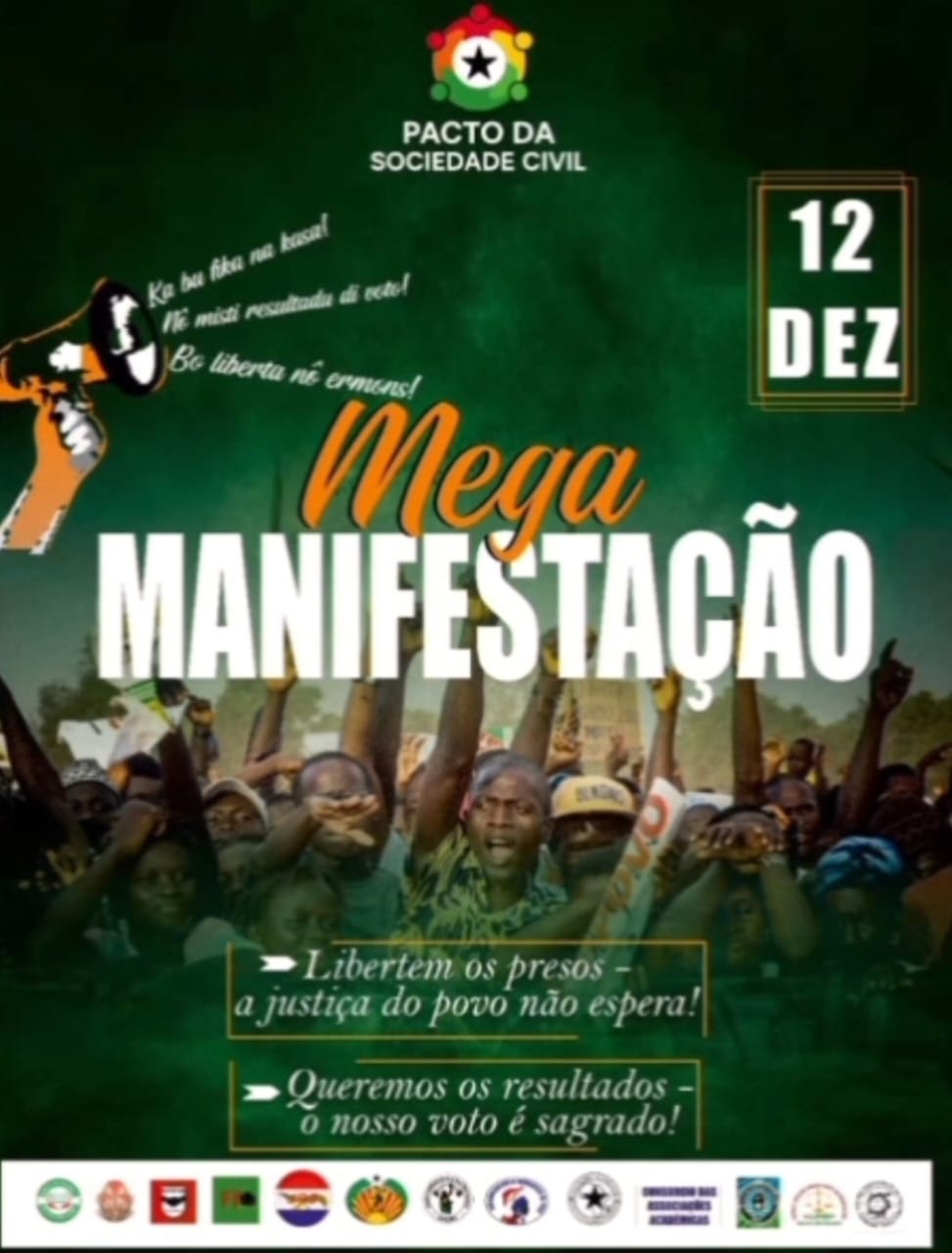
Meanwhile, 13 Guinea-Bissau civil society organisations have, in a trending notice, called for “a national mega” anti-coup protest on Friday, 12 December.
A spokesperson said the group is demanding the installation of independent candidate Fernando Dias as president. Dias is under the protection of Nigeria, a regional power, in Guinea-Bissau, where ECOWAS also has a Stabilisation Support Mission (ESSGB) of about 500 troops
The military junta has banned political demonstrations or rallies.
Other civil society groups from Senegal and Guinea-Bissau have also called on ECOWAS to ensure that Dias is installed, despite the CNE’s claim that it could not proceed with the electoral process because soldiers invaded its headquarters and carted away sensitive materials and computers, including the server.
The group, including Afrikajom Centre, Frente Popular, Africtivistes, and Sen-Canddhu, “demand the immediate proclamation of the results of the 23 November 2025 presidential election in Guinea-Bissau.”
They argue that “it is the only step to respect the will of the people and restore constitutional order” in the country.
ECOWAS has declared a regional state of emergency following renewed military incursions in politics, after a coup attempt in Benin on Sunday, which Nigeria helped to foil.
On Thursday, President Patrice Talon of Benin received a delegation of senior Nigerian army officers led by Brig.-Gen. IB Sheriff to express his gratitude for the timely intervention that dislodged the coup makers.
ECOWAS leaders will meet in Abuja, Nigeria, on Sunday, 14 December, with peace and security expected to dominate the agenda.
Already, five of the regional bloc’s 15 member States – Mali, Burkina Faso, Guinea, Niger and Guinea-Bissau – are now under military rule, with Guinea expected to hold transitional elections this month, while the juntas in Mali, Burkina Faso and Niger have pulled their countries out of ECOWAS to form the Alliance of Sahel States, AES.
Analysts believe that political leaders are largely to blame for the political and leadership crises in the region. Many of them have replaced democratic governance with impunity, isolating the citizens they are supposed to serve through authoritarian policies, suppression of opposition, corruption and cronyism, manipulation of national constitutions for tenure elongation, rigging of elections and shrinking of the civic space.
Their common trend is blatant human rights violations and “political, constitutional and ballot box coups,” which are as dangerous as military coups, all resulting in and/or enabling unconstitutional change of governments and bad governance.
Paul Ejime is a Media/Communications Specialist and Global Affairs Analyst