
*Says Global Governance Initiative will restore stability to the world
By Citizenship Newspaper
As President Xi Jinping’s proposal for a new world order under the Global Governance Initiative (GGI) framework gathers momentum, the Chinese Ambassador to Nigeria, Mr. Yu Dunhai has said that the GGI will restore peace and orderliness to the world.
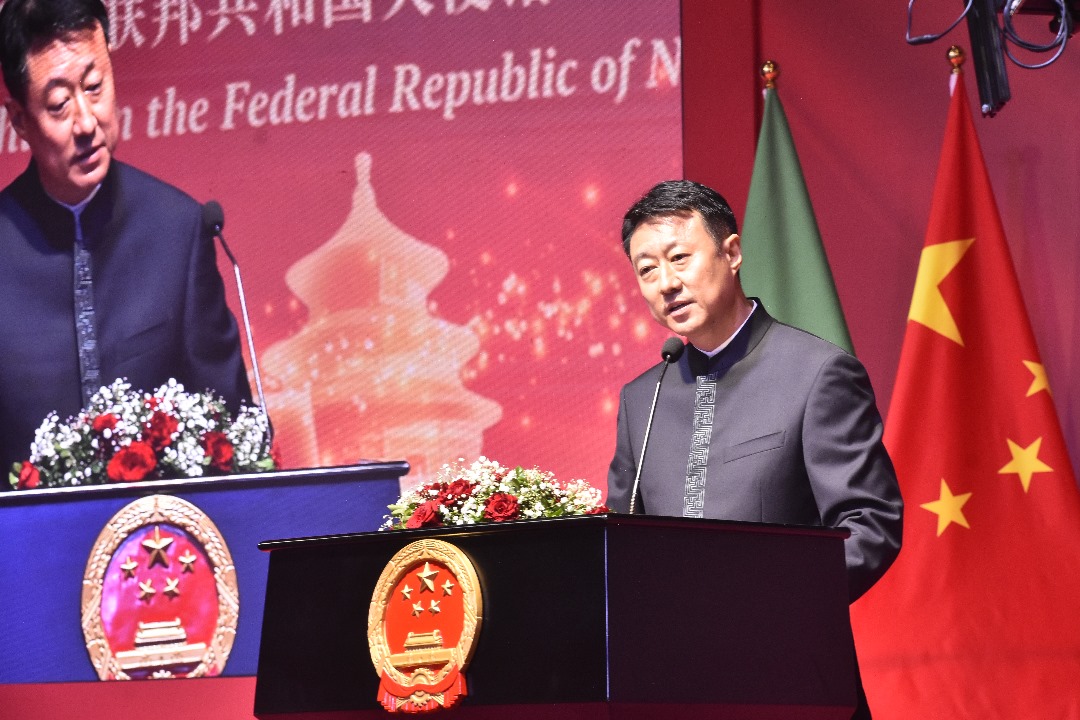
Ambassador Dunhai spoke on Wednesday night in Abuja, Nigeria’s capital in remarks he delivered at the reception celebrating the 76th anniversary of the founding of the People’s Republic of China.
The event, organised by the Chinese Embassy, was attended by dignitaries including the representative of the Deputy Senate President, Senator Babangida Hussaini, Minister of Budget and National Planning, Senator Abubakar Bagudu, the Deputy Governor of Kano State, some ministers, senators, and members of the House of Representatives, ambassadors and heads of international organizations.
Ambassador Dunhai said eighty years after the founding of the United Nations to serve as the multilateral organ to promote global peace and security, China has come up with the Global Governance Initiative, to contribute “Chinese wisdom and solutions to strengthen and improve global governance, injecting stability and certainty into a turbulent world.”
Dunhai said the Global Governance Initiative embodies five core principles: adhering to sovereign equality, abiding by international rule of law, practicing multilateralism, advocating the people-centered approach and focusing on taking real actions.
“Together with the Global Development Initiative, Global Security Initiative, and Global Civilization Initiative, it forms the “four pillars” for building a community with a shared future for mankind,” he said.
He said that the Global Governance Initiative had earned widespread acclaim and echoes.
“Days ago, the Nigerian government issued a statement to endorse the Initiative. China deeply appreciates this support and backs Nigeria’s greater role on the international stage.
“We are ready to work with Nigeria and African countries to advance cooperation under the framework of the GGI,” he said.
He added that this year also marks the 25th anniversary of the Forum on China-Africa Cooperation (FOCAC), noting that over the past 25 years, China and Africa have adhered to principles of sincerity, equality, mutual benefit, and common development. We foster a cooperation model that is equal, pragmatic and efficient.
He said China has remained committed to supporting Africa’s integration and enhancing its capacity for self-driven development.
“A number of cooperation plans have focused on Africa’s priority areas such as infrastructure, investment, trade, agriculture and finance, continuously empowering Africa’s development.
“Last June, Chinese President Xi Jinping announced that China will implement a zero-tariff policy for 100% of tariff lines on products from all African countries that have diplomatic relations with China. These new measures will boost Africa’s strategic autonomy and development, opening a new chapter in high-quality China-Africa cooperation.”
He recalled that one year ago, President Bola Ahmed Tinubu had paid a state visit to China when the two leaders decided to elevate our bilateral relations to a comprehensive strategic partnership, which charted a new blueprint for China-Nigeria relations in the new era.
“Over the years, China-Nigeria relations have witnessed strong momentum. Our Foreign Ministers have met three times. Our legislatures have maintained close communication and exchanges.
“It is worth noting that President Tinubu appointed Joseph Tegbe as Director General for Nigeria-China strategic partnership.
“Over the years, China and Nigeria stand side by side as major developing countries. Nigeria joined the BRICS family, and became a founding member of the International Organization for Mediation. Nigeria firmly supports the one-China principle in bilateral and multilateral settings, and contributes to global governance reform, international fairness and the collective interests of the Global South.
“Over the years, our cooperation has brought tangible benefits to Nigeria people. The Lekki Deep Sea Port has become a new “national gateway” for Nigeria’s global trade. It is expected to generate $360 billion in economic benefits and create 170,000 jobs over the next 45 years.
“The Abuja Water Supply Project was completed in June. With a daily capacity of 480,000 cubic meters, it will meet the clean water needs of nearly 3 million people.
“Chinese companies are in talks with Nigeria to build Africa’s first local insulin production facility, potentially ending Nigeria’s reliance on imported insulin and positioning Nigeria as a hub for African medical biotechnology.
“Over the years, I have visited Lagos, Kano and Ogun states, and I have made many new friends. I am very much impressed by Nigeria’s natural beauty, splendid and diversified culture, and most importantly, its friendly, hospitable and passionate people.
“Not long ago, as the first Nigerian female train driver trained by CCECC, Ms. Issah Fatimah Abiola, known by her Chinese name Bai Yang by Chinese netizens, was honored with China’s “Friendship Envoy Award”, one of only six global recipients. Her story inspires many Nigerian women to strive for self-reliance, becoming a shining symbol of China-Nigeria friendship.
“Equally impressive is a young boy from a bilingual school in Kano, Ibrahim Ismail. The first time I watched the video when Ibrahim speaks Mandarin Chinese, I felt totally amazed. He is not only fluent, but without any accent. Ibrahim is with us today. Well done!”
Ambassador Dunhai expressed China’s commitment to stand ready to deepen cooperation with Nigeria across various sectors.
“We will align our policy with Nigeria’s “Renewed Hope” agenda and eight priority areas, so as to promote more cooperative projects and advance China-Nigeria relations to new heights.”
The event was filled with cultural displays by artists of the Shenzheng delegation from China who staged magnificent performances and cultural dances.