By Godwin Agia, Jalingo
The Association of Civil Society in Malaria Control, Immunization and Nutrition, ACOMIN, has warned that Taraba State must not return to the days of poor health services and preventable deaths as the Global Fund Grant Cycle 7, GC7, winds down by 2030, urging governments, the private sectors, philanthropists and other stakeholders to sustain the gains recorded through Community-Led Monitoring, CLM.
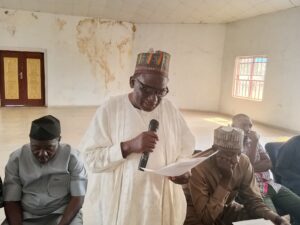
Alhaji Muhammad Tanko Danburam, ACOMIN State Chairman, made the call on Tuesday during the State Media Meeting on the Global Fund Integrated Community-Led Monitoring Project being implemented by ACOMIN, held under the theme ‘Sustaining Community-Led Monitoring Achievements Beyond Donor Funding’.
He explained that CLM empowers communities to identify health service-delivery gaps and advocate for solutions across HIV/AIDS, Tuberculosis and Malaria, ATM, services, noting that Global Fund support over the years has brought significant improvement in healthcare access, availability, acceptability, quality, accountability and outcomes, particularly for underserved and vulnerable populations.
According to him, sustaining the gains will require government investment, local resource mobilisation, tracking, and continued community participation and ownership, stressing that the transition must move from heavy donor dependency towards sustainability, not abandonment.
He noted that CLM has contributed to improved health outcomes through improvements in healthcare facility infrastructure, access to potable water and electricity, provision of essential equipment and supplies, support in addressing staffing shortages, and strengthened collaboration between communities and healthcare providers.
Danburam explained that in Nigeria, the interventions have also contributed to Domestic Resource Mobilisation, DRM, with contributions valued at approximately N1.7 billion across 13 states between 2019 and 2022. Between 2023 and 2025, contributions across 25 states and the Federal Capital Territory, FCT, were valued at N657,864,950.00, while in 2026, contributions across 13 states were valued at N379,245,034.83.
He noted that in Taraba State, key achievements include the donation of a temporary health facility for Tati PHC in Dutse Ward, Takum LGA; community self-funding of HIV testing strips for ANC screening at Kasuwan Ladi PHC, Bakin Dutse Ward, Ardo-Kola LGA; provision of BP apparatus, stethoscope and thermometer for Taka-Wurkum PHC, Gassol LGA; construction of a staircase to improve access to healthcare by the Chediya community in Wukari LGA.
This he said was achieved through 100 per cent community contribution; replacement of damaged roofing at Tudun Haske PHC, Donga LGA; community advocacy securing emergency transport for Kassa PHCC, Yorro LGA; and repair and repainting of the drugs box at Sansani Dispensary through community contribution.
Danburam urged state and local governments to prioritise health financing, integrate CLM evidence into health plans and policies, allocate domestic resources to improve health services and strengthen accountability structures.
He called for specific budgetary provisions for rehabilitation of healthcare facilities, provision of essential medicines and medical equipment, access to clean water and electricity, and recruitment or deployment of adequate health personnel, based on gaps identified through CLM reports.
He further encouraged communities, traditional and religious leaders, civil society and community-based organisations to sustain monitoring, document challenges and engage decision-makers to resolve identified gaps, stressing that such participation should complement, not replace, government’s responsibility to finance and deliver improved healthcare.
Danburam said the organization will continue to facilitate community engagement, intensify stakeholder collaboration, promote domestic resource mobilisation and protect CLM gains, while supporting documentation and dissemination of community-generated evidence and advocating for integration of CLM findings into government health planning, budgeting and accountability frameworks.
“We call on governments, the private sectors, philanthropists and other stakeholders to sustain the gains made on health care improvement through resource allocation and action on community-generated evidence. Health agencies and facility managers should address identified gaps, while communities and civil society sustain engagement, advocacy and accountability. Development partners should provide financial and technical support, while the media amplify community voices and track commitments to improve health outcomes.
“The close-out of GC7 should be seen as a transition from heavy donor dependency towards local ownership and sustainability, not an endpoint. Sustaining CLM achievements requires government commitment, institutional accountability, increased domestic resource mobilisation and meaningful community participation.
“ACOMIN therefore calls on all stakeholders to move beyond commitments to concrete actions that will protect the gains achieved, strengthen healthcare systems and guarantee continued access to quality, equitable and people-centred healthcare services for all Nigerians,” he said.
Implementing partners at the press briefing pledged to continue working closely with ACOMIN to ensure that the fight against HIV, tuberculosis and malaria in the communities does not fail.