


By Saidu Abubakar
While this article is not intended as a history lesson on China’s developmental assistance and projects to Africa and other developing countries in general, the handover of the ECOWAS Secretariat Building, which was single-handedly built by the Chinese Government with an additional three years of free maintenance, is a good case study of what could be described as ‘developmental diplomacy.’
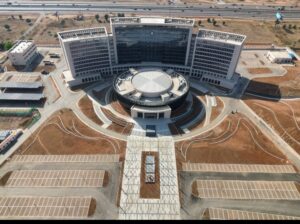
The commissioning and handover of the new ECOWAS Secretariat building is an extension of China’s support to countries in Africa and other developing world in multi million dollars projects. The building was commissioned in Abuja, Nigeria’s flourishing political capital on Tuesday April 28.
Despite uncritical skepticism in certain quarters about China’s true intentions, records show that palpable assistance in developmental projects to African countries started in the mid-1950s with the 1955 Bandung Conference which was attended by 28 Asian and African states.
This intercontinental conference marked the beginning of modern South-South cooperation and a significant starting point of China’s consistent assistance to many African and developing countries. The first major recipients of China’s aid were Algeria, Egypt, Guinea, Sudan in 1956. In 1963-1964 Premier Zhou Enlai made a 10-country Africa tour paving the way for many bilateral agreements. In particular, China established ties with Ghana’s Nkrumah to begin economic, technical and military support to African countries and liberation movements.
In terms of physical projects, the first major project undertaken by China to assist Africa, took place between 1970-1975 when China built TAZARA Railway linking Zambia-Tanzania with RMB988 million (about $406M) interest-free loan, repayable 1973-2013. This project was very significant because Western donors refused to offer loans or any assistance to build it. Rebuffed by Western aid agencies, newly independent Tanzania and Zambia accepted help from China. The railway assisted in redirecting the mineral wealth of the interior away from routes through South Africa and Rhodesia. Indeed, by 1978 China is acclaimed to have given aid to more African countries than the United States despite being one of the so-called developing or poorest countries.
The 1980s witnessed the formalization of South – South cooperation agreements and significant assistance from China to many African Countries and indeed many other developing nations. Within this period China is said to have provided foreign aid to at least 74 countries, many of them in Africa. In fact, by 1984, China became the 8th-largest bilateral donor to sub-Saharan Africa. The 2000s or the Y2K era saw the institutionalization of China – Africa cooperation agreements with the coming into existence of the first Forum on China-Africa Cooperation (FOCAC). In the year 2006 for example, at the FOCAC meeting, Hu Jintao pledged to double 2006 aid by 2009 with $5B preferential credits, $5B development fund which were actually achieved. Another major benevolent gesture which was displayed by China in the period 2000-2009 was the cancellation of over $10bn in debt owed by African nations in addition to at least $3.4B in zero-interest loans cancelled between the same period. Yet between the years 2002-2007 China offered $33B plus in government-sponsored aid and investments, over half of the amount was spent in infrastructural development.
From the year 2013 to date, China intensified and solidified its assistance with many railways, road and building projects in Africa too numerous to be itemized in a write up such as this. Among the standout projects of this era are the rehabilitation of the TAZARA railway project, the Belt and Road initiative, the AU Headquarters Building, the Burkina Faso Parliament Building, the Parliament Building, Zimbabwe, Parliament Building, Malawi, Foreign Ministry Building, National Stadiums for Tanzania, Mozambique and Zambia, and now the ECOWAS Building in Abuja, etc. Each of these projects costs millions of dollars from the Chinese tax payers to support the African states mentioned.
China’s Assistance Projects, Theatrics or True Benevolence
Accordingly, the frequently asked question about China’s development projects in Africa can be interrogated. Are these projects mere theatrics or genuine benevolent heart-heart assistance to Africa? To discuss this question fairly and without prejudice, it is important to look at the European and the American approach to assisting African states and the developing world. By this, the reader is provided with the background that can inform objective decisions.
Western European and American approaches to assisting developing countries including Africa are mainly through aid, grants/loans with varying conditions, cash transfers, budget support, project funding via USAID, EU, World Bank. These grants often come with conditions such as allowing freedom of speech and multiparty democracy, institutionalization of anti-corruption law, human rights, free market reforms, IMF structural adjustment programmes to say just a few. In the case of China, such conditions are not required and, in some cases, even after military coups, China still continues with its developmental projects.
As mentioned earlier, this is not intended to be a history lesson on China’s assistance/initiatives on Africa but a short review of whether these assistance are truly good gestures or mere theatrics to mask China’s hidden intentions. From the information available thus far, the following facts can substantially define China’s assistance project in the past seven decades since China started giving one form of assistance or another to Africa:
1). China assistance projects tend to be open and without hidden conditionalities both before and after the completion of their projects. China has typically not just handed over all its donated projects on time but does not show any evidence of reneging on the terms of engagement.
2). All Chinese projects do not seem to come with requests for changes in government policy, structure and or composition. Furthermore, projects seem to continue even after changes in government whether military or civilian. This seems to demonstrate China’s support for continuity of project life span without political prejudices or preferences.
3). Most Chinese projects are completed on schedule and with at least three years maintenance guarantees at the expense of the Chinese tax payers. This assures not just longevity of the project but gives the beneficiaries ample time to master how to handle such projects after the exit of the Chinese.
Finally, while not being oblivious of critics who argue that these “Chinese gifts” tend to give China trading advantage with many African countries, this criticism itself is weak because bilateral, multilateral and international trades are dependent on many considerations and factors. To single out China’s assistance projects to African and other developing countries as a major factor giving China any significant advantage over the Europeans and the Americans is an oversimplification of the issue.
Saidu Abubakar, PhD, the General Manager/Analyst at Citizenship Daily Newspapers, Abuja is reachable via:
@drsaiduabubakar@gmail.com





This is a remarkably insightful and intellectually grounded piece. The author demonstrates a firm grasp of historical context, carefully tracing the trajectory of China–Africa relations from the Bandung era to contemporary development partnerships. What stands out most is the balanced and measured tone,rather than resorting to simplistic narratives, the writer thoughtfully interrogates both the intentions and outcomes of China’s engagements on the continent.
The discussion of “developmental diplomacy” is particularly compelling, as it highlights a dimension of international relations that is often misunderstood or oversimplified. By juxtaposing China’s infrastructure-driven, largely non-conditional approach with the Western aid model, the author provides readers with a broader analytical lens through which to assess global partnerships. This comparative framing significantly strengthens the argument and enhances its relevance to current policy debates.
Equally commendable is the clarity of expression and logical flow of ideas, making a complex subject accessible without sacrificing depth. The article not only informs but also stimulates critical reflection on Africa’s development choices in an increasingly multipolar world.
Overall, this is a thoughtful, well-researched, and timely contribution. The author deserves commendation for advancing a nuanced and evidence-based discourse.