From Victor Edozie, in Port Harcourt
“The water used to feed us. Now it kills.”
— Barinee Wiyo, fisherman from Bodo community
The Living Shadow of Oil
The air in Ogoni land carries a sharp, metallic scent — a mix of oil, smoke, and decay. In the creeks once alive with fish and crabs, a rainbow sheen of crude floats on the surface, glistening under the humid Rivers State sun.
To the people who live here, this is not an isolated accident. It is everyday life. Nearly three decades after the world first learned of the oil pollution crisis in Nigeria’s Niger Delta, the people of Ogoni still live in the shadows of a poisoned environment.
A Legacy Written in Oil
Ogoni land, located in Rivers State, southern Nigeria, is home to more than 800,000 people across communities such as Bodo, K-Dere, Goi, and Kpean. When crude oil was first discovered beneath its wetlands in the 1950s, many thought prosperity had arrived.
Instead, what followed was ecological devastation.
Shell Petroleum began drilling in Ogoni land in the late 1950s, extracting millions of barrels over the following decades. The profits flowed outward — to corporations and the government — while the environmental costs stayed behind. Gas flares burned continuously, pipelines corroded, and oil spills blackened rivers and mangrove forests.
By the early 1990s, the people had had enough. Led by writer and activist Ken Saro-Wiwa, the Movement for the Survival of the Ogoni People (MOSOP) rose in protest, demanding environmental justice. The world took notice, but the regime of the day responded with force. Saro-Wiwa and eight others were executed in 1995 — a moment that transformed Ogoni land into a global symbol of resistance.
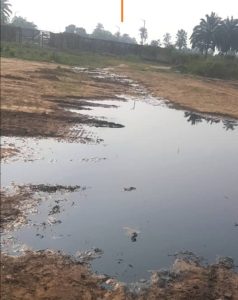
A Land Still Bleeding:
More than 20 years later, the pollution persists. A 2011 United Nations Environment Programme (UNEP) report confirmed what residents already knew: contamination in Ogoni land was extreme, with groundwater containing benzene — a known carcinogen — at levels 900 times above the World Health Organization’s safety limit.
UNEP recommended a comprehensive cleanup spanning 25–30 years. In 2016, the Nigerian government launched the Hydrocarbon Pollution Remediation Project (HYPREP) to implement those recommendations.
Yet progress has been slow. While a handful of pilot cleanup sites have been completed, much of Ogoni remains contaminated.
In Bodo, 54-year-old Barinee Wiyo , a fisherman, gestures toward the blackened shore near his home.
“The water used to feed us,” he says softly. “Now it kills.”
For Grace Wikabari , a farmer in her sixties, even the soil betrays her. She digs into the ground with a stick and sniffs. “We plant, but nothing grows well,” she says. “The oil has entered the land.”
The Executive Director of the Youths and Environmental Advocacy Centre (YEAC-Nigeria), Dr. Fyneface Dumnamene Fyneface , said Ogoni, like many other communities in the Niger Delta has continued to suffer environmental degradation following decades of oil mining activities.
He said the Ogoni case is peculiar due to the fact that it was in the Ogoni area.
“Through the Movement for the Survival of the Ogoni People (MOSOP) from the 1980s to the 1990s that environmental degradation awareness did not only assume national dimension but international publicity thus, focusing attention on the Niger Delta for the benefits today, of many other communities across the region.
“Meanwhile, despite the awareness about environmental degradation in Ogoniland where oil was first discovered in 1958 and over 30 years of oil extraction before Shell was declared a person no grata in 1993, suspending oil extraction until today, the carbon footprints still hunts Ogoni and its people.
“Attempts to address the environmental degradation through the implementation of the United Nations Environment Programme (UNEP) Report of August 4, 2011 is not giving the people, the expected hope of environmental justice and restoration as a greater part of Ogoniland is still polluted despite the presence of the Hydrocarbon Pollution Remediation Project (HYPREP) of the Federal Ministry of Environment since the inauguration of the project in June 2016 with $1billion take off fund meant for the first five years yet to be holistically released, over nine years into the project.
“It is imperative to note that if steps are not taken to address environmental degradation and restoration of the Ogoni environment, an average Ogoni person that UNEP Report (2011) said had lived with pollution throughout his or her life may not experience a restored environment in his or her lifetime. Hence,” he said.
Dr. Fyneface Dumnamene Fyneface called on the polluters of Ogoni environment to ensure the timely funding of the cleanup project and emergency declared on it to suspend certain extant laws such as the Public Procurement Act slowing down the project.
Ogoni women raise concern over 2976 oil spills recorded in their communities:
A coalition of Ogoni women recently raised concern over what it described as 2976 oil spills recorded in their communities in the past 15 years.
The leader of the group Mrs Lezina Ntentep said that the oil spill occurred in 15 years period between 1976 and 1991.
Ntentep said that Ogoni land witnessed first major oil spill in 1970 arising from an error by Shell saying that the spill continued for 3 whole weeks with devastating consequences for the livelihood of the people.
She said that the women of Ogoni ethnic nationality have bear the burnt of oil exploration activities in their respective communities and threatened that they will resist every efforts made by federal government to resume oil production and exploration activities in their communities.
She said that the poor state of their environment is not conducive enough to guarantee safe oil production and exploration activities.
Ntentep said the ongoing frenzy to resume oil extraction in Ogoniland, the concerns raised in the Bill of Rights which led to the termination of oil extraction and the repression of the people, have not been addressed.
She said that no attempt was made to secure justice for the countless families of Ogonis that lost lives, livelihoods and properties in what she said is still the worst attack on a peaceful indigenous population by Nigerian security forces.
She noted that the persons who committed acts of genocide and abuses against unarmed populations, and boasted publicly about it, have not been brought to justice.
She said, “In 1970, Ogoniland witnessed Nigeria’s first major oil spill arising from an error by Shell, a spill that continued for 3 whole weeks with devastating consequences for the livelihoods of the people. Since then, oil spills and blowouts have occurred on a regular basis in Ogoniland. Estimates have that in the 15-year period between 1976 and 1991, there were 2,976 recorded oil spills in Ogoniland.
” Resumption in their Land
In 1958, Ogoniland emerged as a focal area within Nigeria’s growing oil economy, contributing major revenues to the country’s economy. Unfortunately, the benefits from oil resources have not reached Ogoni people, particularly the women in any significant measure. Rather, Ogoni women and its communities have for decades borne the impacts of the industry’s adverse activities.
“It was this level of neglect and ecological destruction which led to the adoption of the 1990 Ogoni Bill of Rights, a landmark document demanding the right of the Ogoni people to protect their environment and ecology from further degradation. Among others, the Bill describes the Ogoni case as a ‘genocide being committed in the dying years of the twentieth century by multi-national oil companies under the supervision of the Government of the Federal Republic of Nigeria.”
“Flowing from the forgoing, it is our recommendation that the government puts a stop to any planned attempt to resume oil activities in Ogoniland. It should rather concentrate on redeeming the ecological disaster in the area, decommissioning aged oil infrastructure, replacing the lost livelihood of the people and securing justice for the countless Ogonis waiting for closure.
“It is disconcerting that in the ongoing frenzy to resume oil extraction in Ogoniland, the concerns raised in the Bill of Rights which led to the termination of oil extraction and the repression of the people, have not been addressed.
“Similarly, there has been no attempt to secure justice for the countless families that lost lives, livelihoods and properties in what is still the worst attack on a peaceful indigenous population by Nigerian security forces. Persons who committed acts of genocide and abuses against unarmed populations, and boasted publicly about it, have still not been brought to justice.”
The group vowed to resist any attempt to resume oil production without addressing all the issues concerning the degradation of their environment occasioned by oil exploration saying that it will mobilize all Ogonis women to go on full nude protest to resist resumption of oil exploration and production activities.
Promises and Disappointments:
HYPREP insists that cleanup work is ongoing and that restoration takes time. The project reports dozens of remediation contracts, local job creation, and community outreach.
But many residents and environmental groups remain skeptical.
According to Environmental Rights Action (ERA), progress is “uneven and opaque.” Critics argue that contracts have gone to inexperienced firms and that oversight remains weak. “There’s a gap between what’s announced and what’s achieved,” says one ERA representative. “We need results, not rhetoric.”
Billions of naira have been budgeted for remediation, but visible impact is limited. Bureaucratic red tape, inconsistent funding, and political interference have all slowed the process.
Health and Survival:
The environmental crisis has also become a public health emergency.
In K-Dere, a community nurse who asked not to be named says she treats patients daily for respiratory problems, rashes, and suspected cancer cases.
“People drink polluted water because there’s no alternative,” she explains. “Clean water should not be a luxury.”
Gas flaring contributes to air pollution, and the contaminated soil seeps into food crops. Women and children are the hardest hit — spending hours searching for water or food that won’t make them sick.
With fishing and farming all but destroyed, poverty deepens. Some young men risk their lives in illegal oil refining an act of desperation that worsens environmental damage.
Echoes of Injustice:
For environmental advocates, Ogoni’s suffering mirrors a global pattern — communities in the Global South bearing the costs of industrial prosperity enjoyed elsewhere.
“Ogoni land tells a story of imbalance,” says a Nigerian environmental researcher based in London. “It’s not just about Nigeria; it’s about how global systems exploit local people. The oil that powered the world left this community in ruins.”
Shell withdrew from Ogoni in 1993, but its legacy remains. In 2021, a Dutch court ordered the company to compensate Nigerian farmers for oil spills — a rare legal victory that offered a glimmer of justice. But translating such rulings into real change on the ground remains a challenge.
Signs of Hope:
Despite everything, hope persists.
Youth groups are mobilizing environmental education campaigns, and NGOs are training women in sustainable trades like beekeeping and aquaculture. Some UNEP-supervised cleanup sites have shown measurable improvement.
Eedee Nwinee, a 26-year-old activist from Kpean, believes her generation must carry the fight forward.
“Our parents fought with their voices,” We’ll fight with science.
Now studying environmental engineering, she plans to return home after graduation. “We have to rebuild what was lost,” she says.
A Long Road Ahead:
Experts warn that without stronger political will, Ogoni’s recovery will remain out of reach. The 30-year cleanup target is already behind schedule. Illegal oil bunkering, vandalism, and weak enforcement of environmental laws compound the crisis.
For residents like Barinee Wiyo and Grace Wikabari , the dream of a clean Ogoni land remains distant but not dead. They hold on to faith, memory, and resilience.
“We have suffered,” Barinee said, gazing over the oily creek. “But one day, maybe, the land will breathe again.”
A Global Reckoning:
The Ogoni crisis is more than a regional tragedy— it’s a global reckoning. As nations race toward clean energy, the scars of old extraction remain open in places like Ogoni.
Environmental degradation here is not abstract. It’s written in the soil, the rivers, and the lungs of those who live among the oil-stained mangroves.
The world owes Ogoni more than sympathy. It owes justice the kind that restores water, soil, and dignity. Until then, the people of Ogoni will continue to live with the question that still hangs in the humid Delta air: Who will heal the land that fed the world?